National Infrastructure Assessment Report 1

Building Foundations for Tomorrow:
Assessing Housing-Enabling Infrastructure Across Canada
National Infrastructure Assessment
Report 1, 2025

Table of Contents
Letter to the Minister of Housing and Infrastructure
About the Canadian Infrastructure Council
Chapter 1: Enabling Housing Through Infrastructure
The current state of our housing-enabling infrastructure
Public transit and active transportation
Infrastructure disparities in Indigenous communities and in the North
The infrastructure impact of daily choices
Existing infrastructure systems alone cannot support future growth
25-year infrastructure outlook
Chapter 2: Tailoring Infrastructure to Regional Realities
Illustrating future regional infrastructure needs
Atlantic communities confronting demographic shifts and climate threats
Central Canada population bracing for significant rising temperatures and rainfall
Meeting population growth and climate challenges in the Prairies
Building resiliency in the West
Navigating change in northern realities
More informed planning starts with improved data accessibility
Chapter 3: Navigating Pressures in Infrastructure Planning and Delivery
Supply chain disruptions delay materials
Workforce gaps in construction delay new projects
Navigating financial pressures
From green bonds to blended finance
Navigating local concerns on infrastructure development
Regulatory processes contribute to project delays and cost escalation
Chapter 4: Planning for Resilient and Liveable Communities
Prioritizing building through density over suburban sprawl
Natural infrastructure and nature-based solutions provide cost-effective, multi-benefit results
Green public spaces boost health and resiliency
Climate-resilient infrastructure pays off
Strengthening infrastructure through smarter asset management
Chapter 5: Building For What Lies Ahead
Recommendation #2: Strengthen coordination across all partners
Recommendation #3: Build for the future with resilience and data at the forefront
ANNEX A: Canadian Infrastructure Council
ANNEX B: National Infrastructure Assessment Report 1 Engagement
ANNEX C: Methodology, Data Sources and Tables
Letter to the Minister of Housing and Infrastructure
Dear Minister Robertson:
The Canadian Infrastructure Council was tasked by the Minister of Housing and Infrastructure to produce Canada’s first National Infrastructure Assessment (NIA), an undertaking that has received broad support across industry, academia, and government. The first mandate has focused on the public infrastructure needed to build more houses, specifically water and wastewater, waste management, and public transit and active transportation systems, the challenges facing these systems due to population growth and climate change.
The Government of Canada has established an ambitious housing agenda that will require significant investment in infrastructure systems. We have an urgent problem to solve and the global economic landscape has changed since we began this work. To meet this moment, we have worked quickly to engage cross-sectoral experts and assemble data and evidence to develop Report 1 of the National Infrastructure Assessment. This report is just the beginning of the Canadian Infrastructure Council’s work.
This first report aims to establish common ground among all interest holders, from policy-makers to infrastructure operators, to effectively address the challenges ahead. Its purpose is not to critique past decisions or existing policies and programs, but to contribute to more effective infrastructure planning and delivery, rooted in data and evidence.
Meeting Canada’s housing and infrastructure demands over the next 25 years and beyond will require a transformative shift in how infrastructure is planned, financed, delivered and managed. The journey to gather the critical data and evidence needed to support sound infrastructure decisions is just beginning.
Much of the country’s infrastructure was built for a different time and is now aging, outdated, or poorly suited to current conditions and long-term needs. And while good data exists in some areas, access to data and evidence to inform decision making is not consistently available or accessible across Canada. A common understanding and coordinated action that is rooted in regionally tailored data and evidence is needed to ensure that infrastructure systems can support new housing and a high quality of life for Canadians.
In this first report, these findings lead us to the following three recommendations:
- Make the most of existing built and natural infrastructure before building new.
- Strengthen coordination across all partners.
- Build for the future with resilience and data at the forefront.
Canada must build, but building alone is not enough. Infrastructure is more than discreet construction projects; it depends on built and natural systems that support and sustain it over time. This includes sound asset management, sustainable investment to maintain it, efficient operations, the ability to scale services to meet future growth, and the responsibility to influence where we want to see that growth.
The Canadian Infrastructure Council has a vital role in advising how to coordinate these efforts and maximize the impact of investments over time. We look forward to continuing this important work.
Sincerely,
| Jennifer Angel Chair of the Canadian Infrastructure Council |
 | Peter Weltman Vice-Chair of the Canadian Infrastructure Council |

Land acknowledgement
This report was developed by the members of the Canadian Infrastructure Council, who reside and work on ancestral and traditional lands across the country.
The Council members honour the peoples and land of all First Nations, Inuit and Métis peoples. The Council respects the histories, languages and cultures of all other Indigenous Peoples, including First Nations, Inuit and Métis, who enrich these communities to this day.
Executive summary
As the country works to address a deepening housing crisis, it must also confront the reality that public infrastructure systems essential to supporting more housing, including water and wastewater, waste management and public transit and active transportation systems, are ill-equipped to support our future needs.
The Canadian Infrastructure Council has produced Report 1 of the National Infrastructure Assessment (NIA) that is focused primarily on these public infrastructure systems, along with the governance, procurement, and financing systems that influence their development and delivery. The report provides initial actions needed to support Canada’s growing population and changing climate. The findings and recommended actions are a first step, creating common ground for solutions that support economic impact, climate resilience and the well-being of all Canadians, both now and in the future.
The Council conducted extensive engagement with more than 150 experts and interest holders between January to April 2025, building on the Government of Canada’s 2021 consultation with more than 300 organizations and experts. Through its engagement, the Council heard that there are very diverse infrastructure needs, alongside uneven capacity, data availability and resources to address these needs in a way that positions Canada to thrive in the future.
By bringing together, for the first time, population projections, asset conditions and climate considerations, this report offers an important starting point. It aims to lay the foundation for a shared reference that supports a coherent and strategic approach to strengthening infrastructure systems, highlighting gaps and pressures and recognizing regional differences.
For some interest holders, this initial report may not go far enough, particularly where compelling data and evidence exist that suggests bold changes are needed to how Canada plans infrastructure. For others, it may go too far by recommending new forms of collaboration and outcome-focused planning that imply fundamental changes in how infrastructure is delivered that may exceed current regional capacity or desire for change. Despite these differences, the Council heard consistent and strong support across sectors and interest holders for a common national framework.
Although the primary focus of this report is housing-enabling infrastructure, the findings have broader relevance across Canada’s infrastructure landscape.
Key findings
- Infrastructure must be tailored to regional realities: Regions across Canada face unique infrastructure needs shaped by varying climate and population pressures – needs that can be met only with planning, data and investment that is tailored to regional and community realities.
- Building new infrastructure faces significant constraints: Building new infrastructure faces barriers including workforce shortages, supply chain disruptions, uncertain investment and regulatory burdens that often delay and/or increase the cost of needed development.
- Significant opportunities exist to meet future needs with existing assets: Improved planning, asset management and operational funding, combined with technological advances and the use of natural assets and nature-based solutions, are cost-effective solutions to many infrastructure challenges.
Recommendations
- Make the most of existing built and natural infrastructure before building new: Before investing in new infrastructure, communities should recognize and optimize the services already provided by existing infrastructure to ensure that every dollar spent delivers maximum value. Key actions include maximizing services from existing built and natural infrastructure, managing service demand to avoid costly expansion, and investing in innovative projects that deliver multiple benefits.
- Strengthen coordination across all partners: Addressing Canada’s infrastructure and housing challenges requires coordinated action among all orders of government, Indigenous nations and the private sector to share knowledge and resources, leverage expertise, reduce barriers and align investment for maximizing impacts. Streamlining regulations, seeding innovation and establishing a pan-Canadian project pipeline can improve efficiency and predictability, attract investment and support vital infrastructure projects to get built.
- Build for the future with resilience and data at the forefront: To ensure infrastructure stands the test of time, governments and industry leaders must make forward-looking, evidence-based decisions that account for evolving climate conditions, population trends and regional differences in risk and capacity. This includes adopting standardized data and tools, transparent risk assessments and climate-resilient designs to avoid costly future retrofits or repairs.
Looking ahead
Canada stands at a pivotal juncture. The infrastructure decisions made today will shape the country’s prosperity and resilience for generations. This report lays the groundwork for a more integrated, data-driven and collaborative approach to building the infrastructure Canadians need to live and thrive, while ensuring future generations can do the same.
A deeper examination is required, nonetheless these findings and recommendations can offer a foundation and shared reference for infrastructure development in Canada.
About the Canadian Infrastructure Council
The Canadian Infrastructure Council (the Council), established under the authority of the Minister of Housing and Infrastructure (the Minister), supports long-term infrastructure planning and decision-making in Canada. Launched in December 2024, the Council is an arm’s length, expert advisory body composed of eleven independent experts from across Canada with diverse experience and expertise in infrastructure-related fields. See Annex A for member biographies.
Mandate
The Council’s mandate is to provide all orders of government with impartial, evidence-based research and analysis, developed openly and transparently, to help improve infrastructure planning and decision-making in Canada. Reporting to the Minister, the Council:
- Develops National Infrastructure Assessment(s) to provide an evidence-based picture of Canada’s infrastructure needs and priorities in the built environment;
- Develops evidence-based research and analysis on key infrastructure issues; and,
- Provides analysis and/or advice on any other matter referred to the Council by the Minister.
To inform its work, the Council draws on a broad range of expertise and diverse perspectives, engaging with experts, partners and interest holders from various sectors and regions across Canada.
The Council assumes an advisory role and does not review or assess the policies or programs of any order of government. Other orders of government retain their decision-making authority in all cases.
Guiding principles
The Council set the following principles to guide its work:
- the importance of evidence-based decision-making;
- the need to improve the efficient use of existing resources;
- the role of infrastructure in supporting sustainable, resilient and inclusive communities; and,
- the need to design projects that achieve multiple outcomes (i.e., multi-solve) while staying manageable and feasible.
Introduction
National Infrastructure Assessments (NIAs) can enable a more integrated, consistent and forward-looking approach to infrastructure planning and decision-making across all orders of government, the private sector and communities. NIAs offer a portrait of existing assets, future needs, regional priorities and delivery challenges and opportunities, as population growth and accelerating climate change place increasing pressure on infrastructure systems.
Scope
The Council was directed to focus the first NIA on the following three public infrastructure sectors that are fundamental to enabling more housing:
- water and wastewater;
- solid waste management;and,
- public transit and active transportation (i.e., community mobility).
Unless stated otherwise, facts and figures defined as “housing-enabling infrastructure” in this report include these sectors only. The Council was tasked with examining the challenges these systems face due to population growth and climate change, and with providing an evidence-based overview of Canada’s infrastructure needs. That said, the evidence, findings and recommendations are relevant across infrastructure systems more broadly.
What we heard
The Council held 13 bilateral meetings, 8 cross-sectoral roundtables and 5 focused discussions with more than 150 experts and interest holders across the country to inform this report. An additional 46 written submissions were received in response to a public Call for Input survey that was held from March 11 to April 14, 2025. See Annex B for the organizations that participated.
Perspectives from engineers, developers, investors, provinces and territories, local governments, Indigenous organizations and leaders, climate experts, community organizations and the broader public were sought on the following questions:
- What are some of the challenges related to infrastructure that would benefit from more thoughtful infrastructure planning, coordination and delivery in Canada?
- What do you believe are the underlying causes of those challenges, and are there any corresponding opportunities or best practices that we can follow to address them?
- Do any of these solutions readily exist or are they being implemented in certain communities in Canada or abroad?
- Complex programs and lack of cohesion in funding landscape: Infrastructure planning and delivery are hindered by fragmented governance that sometimes works at cross purposes, as well as short-term and restrictive funding programs that do not match local timelines or capacities for implementation.
- Climate-resilient design considering the full infrastructure lifecycle: Current infrastructure systems are not built to withstand increasing climate risks. To address this, there is a need for better access to, and routine use of, climate data and tools, updated standards, early integration of climate-resilient designs, and investment models that support shared and long-term benefits. Additionally, progressive procurement models are necessary to promote innovation and risk-sharing leading toward increased use of nature-based solutions and low-carbon materials.
- Planning and data gaps: Better data and planning are essential for strategic infrastructure decisions, including stronger asset management plans, access to and integration of climate and population projections, and support for smaller communities to plan for the long-term.
- Unique circumstances in northern, Indigenous, rural and remote communities: These communities face distinct challenges in planning and delivering infrastructure, underscoring the need for more equitable, tailored and locally led approaches that reflect higher costs, seasonal constraints and geographic isolation, aging systems and distinct local capacities.
- Barriers to more innovative infrastructure approaches: Risk aversion in procurement approaches, slow adoption of emerging technologies and nature-based solutions, labour and skill shortages and regulatory barriers often hinder innovation. Progressive procurement, pilot projects, flexible delivery models and workforce development can optimize resources and accelerate sustainable infrastructure solutions.
We thank all participants for sharing their time, knowledge, experience and insights to inform this report. For more detailed insights and information on the engagement process, please see our What We Heard: Planning for Canada’s first National Infrastructure Assessment.
Chapter 1: Enabling Housing Through Infrastructure
| CHAPTER SUMMARY |
|---|
| Canada faces a growing housing crisis driven by rapid population growth and a need for housing delivery that is unable to keep pace. Many systems, like water, transit and waste, are aging, lack capacity to accommodate recent and projected growth, and are often vulnerable to a changing climate. Fixing this is urgent. More than $126 billion of housing-enabling infrastructure is in poor or very poor condition and at risk of failure in the near-term.[i] Climate change, rising demand, and persistent gaps in Indigenous and remote communities are compounding pressures. Better use of existing built and natural assets, through conservation, changes in consumption and use, density, and better planning can help, but it will not be enough. New, resilient infrastructure that meets new and changing conditions must be built alongside housing. Without it, Canada risks compounding a housing crisis with an infrastructure crisis. |
Canada is in a housing crisis, driven by rapid population growth. Our population grew by 3.0% in just one year (reaching 41.3 million people in July 2024), which was the fastest growth since 1972.[ii] We face a shortfall of millions of homes, with affordability slipping out of reach for many Canadians, particularly young people, newcomers and marginalized communities.
Housing demand in Canada is expected to continue to increase in the short-term as the population may grow up to 46 million in 2035.[iii] The Parliamentary Budget Office estimates that 290,000 housing units need to be built annually to close the housing gap,[iv] 65,000 more per year than are expected.[1] By 2074, Statistics Canada estimates that Canada’s population could be as high as 81 million people under a high-growth scenario, suggesting that housing pressures could persist and potentially intensify over time.[v]
Housing and infrastructure are two sides of the same coin. Solving the housing crisis means ensuring that infrastructure systems, like transit, water and wastewater and waste management, can support the added population. Relying solely on aging, and in some cases overstretched, infrastructure to accommodate a growing population risks exacerbating existing challenges.
Figure 1.1: Connecting housing with the infrastructure that supports everyday life.
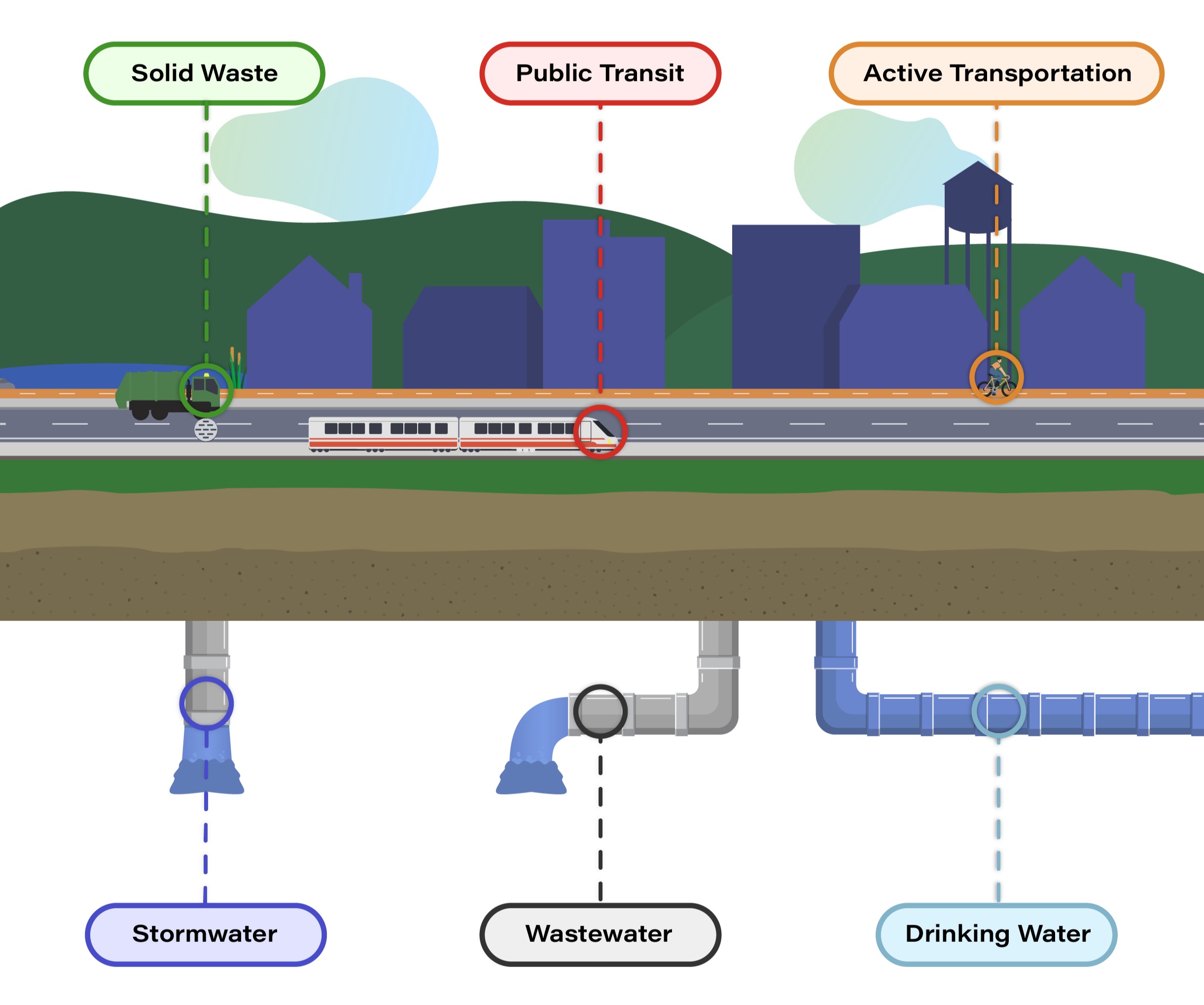
As we work to support more housing and expand infrastructure capacity, it is essential to leverage the infrastructure we already have. This requires a shared understanding of where infrastructure exists, its condition and capacity, and how these systems are interconnected. This insight is critical for guiding growth strategies, optimizing existing infrastructure assets, targeting investments in high-growth areas, and retrofitting or repurposing infrastructure in communities.
The current state of our housing-enabling infrastructure
Canada’s infrastructure is aging, and in many cases requires repairs in the near-term just to maintain existing service levels. In 2022, 11% of housing-enabling infrastructure was classified as being in poor or very poor condition, with an estimated replacement value of $126 billion.[vi] The following sections take a closer look at the current conditions of Canada’s housing-enabling infrastructure assets, gaps and disparities before outlining potential opportunities.
Water and wastewater[vii]
In 2022, more than 11% of water and wastewater-related assets in Canada were in poor or very poor condition, with an estimated replacement value of $107 billion.[viii] Additionally, significant disparities in access to quality services persist between Indigenous and non-Indigenous communities. Looking ahead, climate change and population growth will intensify pressure on water and wastewater systems and require proactive planning and investment to ensure resilient and equitable access to water and sanitation for all.
Water losses in Canada have increased from 13% in 2011 (673 million litres (L)) to 17% in 2021 (806 million L) of total drinking water use, roughly equivalent to the total drinking water consumed in British Columbia in the same year (807 million L).[ix] Historically, Canada has had significantly worse leakage rates than peer countries, largely due to insufficient water loss control practices (e.g., leak detection and repair).[2] In addition to using more energy and other resources, water systems are vulnerable to water main breaks and other disruptions as a result of insufficient water loss control practices.
Solid waste management
While solid waste infrastructure is generally in good physical condition across the country,[x] concerns remain about future capacity, especially as solid waste volumes are driven by population, economic growth and consumption habits.[3] Though the percentage of solid waste diverted from landfills and incineration (waste diversion rate) rose from 21.6% in 2002 to 27.1% in 2022, [xi] landfill shortages could occur within the next decade in some regions, like Ontario and parts of Quebec.[4],[5] Many remote and northern communities lack access to even basic waste management infrastructure, like engineered landfills and recycling depots, and face high costs and logistical barriers.[6] Proper management of solid waste is important, as landfills emit methane, a potent greenhouse gas, and shifting weather patterns, specifically increased rainfall and flooding, may increase leakage (i.e., leachate) that can contaminate nearby soil and pollute water.
Public transit and active transportation
In 2022, more than 13% of public transit related assets in Canada were in poor or very poor condition, with an estimated replacement value of nearly $15 billion.[xii] While only 7% of active transportation infrastructure was in poor or very poor condition, the condition of over 40% was unknown in 2022.[xiii] Public transit and active transportation provide affordable access to jobs and amenities, while offering environmental, health and social benefits, particularly in densely populated areas where shorter travel distances and better infrastructure make them more viable.[7] Larger communities benefit further from these systems due to reduced congestion. In contrast, smaller communities often lack alternatives to private vehicles.[8] Many neighbourhoods also lack adequate cycling infrastructure.[9] To support growing communities effectively, mobility systems must be integrated with land use and housing development planning and take into consideration population growth.
| Climate impacts |
|---|
Canada’s infrastructure has faced major service disruptions in recent years due to natural hazards including intensifying storms, heat waves and wildfires, underscoring the urgent need to adapt existing infrastructure to future conditions and plan proactively for recovery following weather-related events. Infrastructure and housing have also been developed in high-risk areas, like river and coastal floodplains, and degradation of natural infrastructure has reduced its regulating influence on hazards like flooding, erosion and extreme heat. Thawing permafrost presents specific infrastructure challenges in Northern Canada. In November 2021, British Columbia experienced catastrophic flooding triggered by record-breaking rainfall, which washed out highways, submerged communities, and forced thousands from their homes. The disaster caused damage to infrastructure, housing and agriculture, with insured losses estimated to be $675 million and total costs in the billions.[10] In May 2023, wildfires threatened the suburban communities of Hammonds Plains and Tantallon in the Halifax Regional Municipality.[11] The fires destroyed approximately 150 homes, saw more than 16,000 people evacuated, and resulted in more than $165 million in insured losses. In July 2024, Toronto experienced a month’s worth of rain in two hours, overwhelming stormwater infrastructure systems causing significant flooding.[12] The cost of the flood damage was close to $1 billion.[13] The cost associated with these events is increasing. In 2024 alone, insured losses from severe weather events reached a record $8.5 billon, in addition to uninsured losses; with these costs borne by households and businesses.[14] Canada’s home, auto and business insurers reported the most challenging summer on record from weather events and natural hazards in 2024, with a 406% increase in claims compared to the previous 20 years on average.[15] |
Infrastructure disparities in Indigenous communities and in the North
Indigenous peoples, particularly those in small and remote communities, face some of the most persistent infrastructure challenges in Canada. For generations, First Nations, Inuit, and Métis communities have had limited access to safe housing, reliable water and waste systems, education, healthcare, telecommunications and other essential services gaps that contribute to deep-rooted socio-economic inequalities.[16] Notably, drinking water advisories in Canada have been disproportionately concentrated on First Nation reserves, with advisories often being sustained for significantly longer periods of time. As of August 29, 2025, 39 long-term drinking water advisories (i.e., lasting longer than one year) were in place on public systems on 37 First Nation reserves.[17]
The Assembly of First Nations and Indigenous Services Canada estimate that $350 billion is needed to close the existing infrastructure gap for First Nations on reserve.[18] Inuit Tapiriit Kanatami estimates that $75.1 billion is needed to close existing priority infrastructure gaps in Inuit Nunangat.[19] There is no comprehensive assessment of current infrastructure needs for Métis. Across Canada, Indigenous communities face unique infrastructure challenges when compared to other remote communities,[20] as a result of long-standing socio-economic marginalization and rapidly growing populations.[21],[22]
Infrastructure deficits are especially pronounced in Canada’s North. Historical underinvestment, harsh climate and remote geography all lead to construction challenges, such as insufficient transportation infrastructure including roads and ports, short seasonal construction windows, permafrost adaptation requirements, and the lack of integrated systems that combine housing, energy, water, transportation and broadband needs.[23],[24],[25] These factors contribute to the northern and Arctic infrastructure deficit, which includes poor quality and overcrowded housing,[26] inadequate public infrastructure,[27] fragile supply chains and logistic networks, and insufficient energy generation and transmission infrastructure.[28] The rapid pace of warming in the North as a result of climate change is increasing the incidence of disasters, severe weather events, and slow-onset events (e.g., permafrost thaw, coastal erosion) which accelerate infrastructure failure.[29]
The infrastructure impact of daily choices
Managing or reducing user demand can ease pressure on assets and improve efficiency. These measures can reduce future infrastructure needs, giving communities valuable time to better plan for future growth and scale up strategically when resources allow.
Water usage
Without demand management practices, such as water metering, Canada’s growing population and relatively high per person water use will place significant demand on water systems. There is untapped opportunity to use water more wisely and avoid the need to build as much new infrastructure in the future.
In 2021, total drinking water use in Canada reached 4.9 billion cubic metres (m³).[xiv] More than half of drinking water use (55%) is by households, followed by industry (28%), and losses from distribution systems (17%).[xv] Despite a downward trend in drinking water use, Canada’s per capita use is still high by global standards. In 2021, average daily drinking water use for all end users (including water losses) was 401 litres (L) per person.[xvi] While this declined from 485 L per person in 2011, it is still significantly higher than most peer countries. Reducing Canada’s per capita average daily drinking water use would reduce the need to expand or build new drinking water treatment plants.
Residential usage makes up the largest proportion of drinking water use and is significantly higher than peer countries. Average daily residential use per capita was 223 L per person in 2021, down from 251 L in 2011,[xvii] whereas the average daily residential drinking water use among 29 European countries was 124 L per person in 2021.[30] This is at least partially driven by higher prices for water usage in these countries. Average water pricing in Europe was nearly €4/m3 (or $6.50/m3) in 2021, compared to an average price in five large cities in Canada of about €1.3/m3 (or $2.00/m3). [31]
Drinking water usage also varies significantly across Canada, ranging from 283 L per person per day in Manitoba to 709 L per person per day in Newfoundland and Labrador.[xviii] Differences in consumption across provinces can be attributed to a number of factors, including higher water losses and differing levels of water metering and conservation practices.
Solid waste production
Most of Canada’s solid waste ends up in landfills. In 2022, only 27% of waste was diverted from landfills or incineration, placing us 17th out of 38 Organisation for Economic Co-operation and Development (OECD) countries, and well behind leaders like South Korea (54%) and Germany (45%).[xix] Even countries with relatively similar economies and geography, like New Zealand (35%) and the US (30%), are doing better. This trend is also seen in our relatively low circularity rate (i.e., a measure of how much waste is reused in an economy) of just 6.1% compared to 11.5% in the European Union.[32] Canada’s low waste diversion rate reflects not only our high consumption level, but also the relatively low cost of landfilling that is made possible by our vast land area and abundant natural resources.
Canada’s overreliance on landfills and low circularity rate signal a missed opportunity to recover valuable materials and reduce environmental impacts. While we are not alone in facing these challenges, other countries are proving that better systems are achievable. Canada has the opportunity to improve how waste is collected, sorted and processed and make it easier and more cost-effective to divert materials from landfills.
Commuting choices
From 2016 to 2024, the proportion of Canadians commuting to work by private vehicle ranged from 79% to 85% and contributed to congestion in many major cities.[xx] Roughly 90% of Canadian households own at least one private vehicle.[xxi] In comparison, public transit was the main travel mode for around 11% in 2024, while around 6% relied mainly on active transportation, with significant variability across the country and between urban and rural communities.[xxii] Access to public transit is low in rural areas, where only 10% of the population lives within 500 metres of a transit stop, compared to 81% of those living in urban areas in 2024.[xxiii] OECD research indicates that Canadians living in urban areas generally have closer access to public transit stops than those in peer US cities, but less than peers in Australia and the European Union.[xxiv]
To a large extent, the high use of private vehicles in Canada is shaped by existing land use patterns, such as where and how closely residential, commercial and social buildings/activities are located. Land use dictates how far people need to travel from one activity to another or to access mobility infrastructure and services (e.g., if residential areas are low-density, people may have farther to go to get to transit). Increased use of public transit and active transportation can support increased housing density. [33] This relationship is also true in reverse as more density would decrease the distance people need to travel to commute to work or access amenities.[34]
Heavy reliance on private vehicles leads to traffic congestion, which wastes time and reduces economic productivity. Sprawl (e.g., expansion of urban areas into surrounding rural land) limits access to jobs, services and opportunities without the use of a vehicle, and increases road congestion as more people drive. Recent estimates indicate the economic impact of congestion in Ontario from 2014 to 2024 at $12.8 billion annually, which increases to $56.4 billion when quality of life impacts are considered.[35] This includes the cost of delayed movement of goods and services, and reduced efficiency from workers, as well as the cascading impacts on investment and employment growth. Reliance on private vehicles often creates social inequalities, as those without access to vehicles face reduced mobility.[36] Overall, too many vehicles on the road strain resources and drive us away from more sustainable cities.
Existing infrastructure systems alone cannot support future growth
While making better use of existing infrastructure and managing demand is critical, more housing and infrastructure will be needed to support growing communities in the context of a changing climate. Enabling more housing, and advancing the underlying infrastructure systems that support it, is a complex, multi-year process that needs to involve multiple entities, interest holders and expertise. Coordinated planning over the next 25 years and beyond is crucial to guide the development of housing and infrastructure, not only now but in the future. This involves building housing where existing infrastructure can be leveraged and adding infrastructure where new housing will be built.
25-year infrastructure outlook
Decision-makers cannot plan effectively if they do not know where population growth could occur. Strategic and long-term infrastructure and housing planning depend on understanding future population growth; without that information, investment risks missing the mark.
Planning for 25 years and beyond (i.e., 50 to 100 year horizons that align with the infrastructure lifecycle) requires data, and population growth projections can guide local decisions on where new housing and related infrastructure services will see future demand.
Tailored, open and transparent projections at a regional and community level would better inform where housing and related infrastructure services are needed, supporting future planning. By leveraging this information, communities can make intentional and informed decisions about where and how infrastructure and housing are built as they evolve.
In the absence of robust projections and simulations, illustrations of the potential scale of future infrastructure needs could be made as a starting point. These illustrative estimates have to rely on the assumption that infrastructure service demand changes proportionally with population growth and decline.
While population growth is a key driver, infrastructure demand is also shaped by urbanization, economic development, technological change, evolving consumption, demographic changes (e.g., aging population, increase in the share of the population with disabilities) and mobility patterns. All of these factors will also be affected by current and future government policies, including those related to housing and infrastructure. For example, current efforts by all orders of government to encourage transit-oriented development are expected to increase transit ridership beyond the estimates below.
In 25 years, if current behaviours remain unchanged, Canada may need:[xxv]
- Clean water: 5.5 to 7.0 billion cubic metres of clean water (4.9 billion in 2021);
- Wastewater: 6.3 to 8.0 billion cubic metres of wastewater (5.9 billion in 2023);
- Waste disposal: 30 to 38 million tonnes of solid waste sent to landfills or incinerators (26 million in 2022);
- Waste diversion: 11 to 14 million tonnes of solid waste diverted from landfills or incinerators (10 million in 2022);
- Vehicles: 28 to 36 million vehicles on the road (26 million in 2023);
- Public transit: 1.8 to 2.2 billion trips taken on public transit (1.8 billion in 2023); and,
- Active transportation: 1 to 1.2 million people primarily walking, running or cycling to work (961,000 in 2023).
These estimates are not predictions, but illustrations of the potential scale of future infrastructure service demand based on low- and high-growth population projection scenarios and unchanged behaviours. See Annex C for more information on how these estimates have been calculated.
Chapter 2: Tailoring Infrastructure to Regional Realities
| CHAPTER SUMMARY |
|---|
| Canada’s infrastructure needs vary widely by region and community type, with larger communities facing housing shortages, congestion and aging systems, while smaller communities often lack basics like clean water, reliable roads, solid waste management and wastewater treatment. This is most concerning in Indigenous communities, although these gaps vary by geography and between First Nations, Métis and Inuit communities. Historic urban development has altered how natural systems function and has placed infrastructure and housing in some areas at risk from natural hazards, like flooding and wildfires. The prevalence of climate hazards can vary by region, with coastal regions facing rising sea levels and stronger storms, the North experiencing rapid permafrost thaw, the Prairies confronting drought and wildfires, and Central and Eastern Canada dealing with more frequent flooding and extreme heat. Population growth will surge in some regions and decline in others. Smaller municipalities often lack the financial and technical capacity to plan for future risks. Larger municipalities are more likely to consider climate change in decision-making,[xxvi] but a one-size-fits-all approach to infrastructure planning would deepen inequalities. Canada needs regionally tailored, data-driven solutions that reflect the geographic, demographic and climate realities of each community to build resilient, inclusive and future-ready infrastructure systems. |
To keep pace with population growth over the next 25 years, regionally tailored approaches are essential to align housing development with infrastructure capacity. Challenges vary across the country: major cities face density pressures and congested roads, while smaller communities struggle with limited resources to maintain or replace aging infrastructure. In remote communities, the gaps are often more severe, ranging from inadequate access to clean water and wastewater systems to the absence of reliable all-season roads, reflecting both geographic barriers and long-standing underinvestment. Infrastructure gaps are more pronounced in remote Indigenous communities than in remote non-Indigenous ones, with a 2019 study identifying Nunavut’s remote Indigenous communities as having the most significant disparities.[37]
Beyond infrastructure issues, population growth and impacts from climate change are also regionally driven in Canada. Small and very small communities cover 98.5% of our overall landmass,[xxvii] and these communities and their infrastructure will be exposed to a variety of climate hazards that will vary across regions given our broad and vast geography. For example, climate change in the North is happening faster and with a greater impact than the rest of Canada. Climate change impacts in the North have already resulted in erosion and/or melting of winter roads, with projections estimating that more than half of current winter roads will become unviable by 2050.[38] Consequently, the impacts from climate change, and measures to improve climate resilience, will also have to vary across regions.
Decision-makers need to understand and incorporate specific regional and community realities into their long-term planning and solutions. The challenges faced by communities are so different in Canada that an approach to infrastructure planning that reflects local realities is required for infrastructure solutions to be responsive, resilient and reflective of the diverse needs of the people they are meant to serve.
Figure 2.1: While Canada possesses an abundance of land, 73% of Canadians live on less than 2% of the land.
Size | Number of Census Subdivisions (CSDs) | Population | Land |
Very small communities (less than 5,000) | 4,394 (85.1%) | 4,164,480 (10.1%) | 7,584,300 (86.3%) |
Small communities (5,000–30,000) | 600 (11.6%) | 7,033,027 (17.0%) | 1,071,629 (12.2%) |
Medium communities (30,000–100,000) | 100 (1.9%) | 5,402,750 (13.1%) | 103,435 (1.2%) |
Large communities (100,000–500,000) | 54 (1.0%) | 9,956,032 (24.1%) | 12,714 (0.1%) |
Very large communities (more than 500,000) | 13 (0.3%) | 14,732,000 (35.7%) | 16,623 (0.2%) |
Total | 5,161 (100%) | 41,288,599 (100%) | 8,788,703 (100%) |
Source: Statistics Canada. Census Profile, 2021 Census of Population. Statistics Canada. Table 17-10-0155-01 Population estimates, July 1, by census subdivision, 2021 boundaries. Classifications by HICC.
Illustrating future regional infrastructure needs
In the absence of robust, regional projections, illustrative estimates can serve as a starting point for understanding the potential scale of future infrastructure needs across Canada’s regions. See Annex C for more information on how these estimates have been calculated.
Atlantic communities confronting demographic shifts and climate threats
As of 2024, the population of Atlantic Canada (New Brunswick, Nova Scotia, Prince Edward Island and Newfoundland and Labrador) was about 2.7 million people.[xxviii] Covering a total land area of around 488,000 square kilometres, the region has a relatively low population density of about 5.5 people per square kilometre. Based on the 2021 Census, there are 135,600 Indigenous peoples (First Nations (59%), Métis (29%), Inuit (7%) and others[xxix] (5%)) living in Atlantic Canada.
Atlantic Canada’s population is projected to realize moderate growth into 2049, with an aging population that will make up an increasing share in much of the region over the next 25 years. As of 2024, almost all municipalities in Atlantic Canada were very small (744) or small (79), representing almost 60% of the population on more than 98% of the land.[xxx] While the few medium, large and very large communities in Atlantic Canada are expected to grow, the very small and small communities are expected to decline under a low-growth scenario by 15% and 8%, respectively.[xxxi]
Figure 2.2: Atlantic Canada is shaped by smaller and coastal communities

Source: Statistics Canada. Table 17-10-0155-01 Population estimates, July 1, by census subdivision, 2021 boundaries
Figure 2.2 long description (click here to view)
Communities by size, Atlantic Canada, 2024
Size | Number of CSDs | Population |
Very small communities (less than 5,000) | 744 (89.5%) | 738,314 (27.8%) |
Small communities (5,000–30,000) | 79 (9.5%) | 850,672 (32.0%) |
Medium communities (30,000–100,000) | 5 (0.6%) | 329,242 (12.4%) |
Large communities (100,000–500,000) | 2 (0.2%) | 233,545 (8.8%) |
Very large communities (more than 500,000) | 1 (0.1%) | 502,753 (18.9%) |
Total | 831 (100%) | 2,654,526 (100%) |
In 25 years, if land use and consumption patterns remain the same, Atlantic Canada might need:[xxxii]
- Housing: 1.1 to 1.4 million housing units (1.1 million units in 2021);
- Clean water: 290 million to 357 million cubic metres of drinking water (285 million in 2021);
- Wastewater: 425 to 526 million cubic metres of wastewater (422 million in 2023);
- Waste disposal: 1.3 to 1.6 million tonnes of solid waste sent to landfills or incinerators (1.3 million in 2022);
- Waste diversion: 567,000 to 705,000 tonnes of solid waste diverted from landfills or incinerators (531,000 in 2022);
- Vehicles: 1.9 to 2.3 million vehicles on the road (1.8 million in 2023);
- Public transit: 32 million to 40 million trips taken on public transit (31 million in 2023); and,
- Active transportation: 69,000 to 85,000 people primarily walking, running or cycling to work (67,000 in 2023).
Atlantic Canada is expected to face more frequent and severe rainfall events.[39] Along with rising sea levels, this will increase flooding risk and coastal erosion.[40] Coastal erosion can also be exacerbated by human activity, such as deforestation.[41] Increased storm frequency and intensity can cause coastal erosion and property damage, creating a financial burden for small communities struggling to relocate houses and build protection walls.[42] Moving forward, new infrastructure will need to be designed and built to withstand these more intense climate situations.
Central Canada population bracing for significant rising temperatures and rainfall
Central Canada, consisting of Ontario and Quebec, is the most populous region in the country. As of 2024, it was home to approximately 25 million people or around 60% of Canada’s total population. Spanning roughly 2.2 million square kilometres, it has an average population density of about 11.5 people per square kilometre, though this varies widely, with dense urban centres like Toronto, Ottawa and Montreal contrasting with vast and sparsely populated rural and northern areas. As of 2024, most municipalities in Central Canada were very small (1,427) or small (327), representing roughly 23% of the population on nearly 98% of municipal land.[xxxiii] The region also holds most of Canada’s large and very large communities, which represent more than 64% of the population on less than 1% of the region’s land.[xxxiv] Based on the 2021 Census, 611,600 Indigenous peoples are living in Central Canada (First Nations 60%, Métis 32%, Inuit 3% and others 5%).
Central Canada is projected to remain home to most Canadians into 2049, with population growth in the region varying widely depending on the scenario. Under a low-growth scenario, overall population growth in the region is estimated to be just 3%, with declines possible in very small and small communities.[xxxv] In contrast, under the high-growth scenario, growth could reach 32%, with all community sizes, especially large and very large ones, seeing significant increases.
Figure 2.3: Central Canada is home to the country’s largest communities
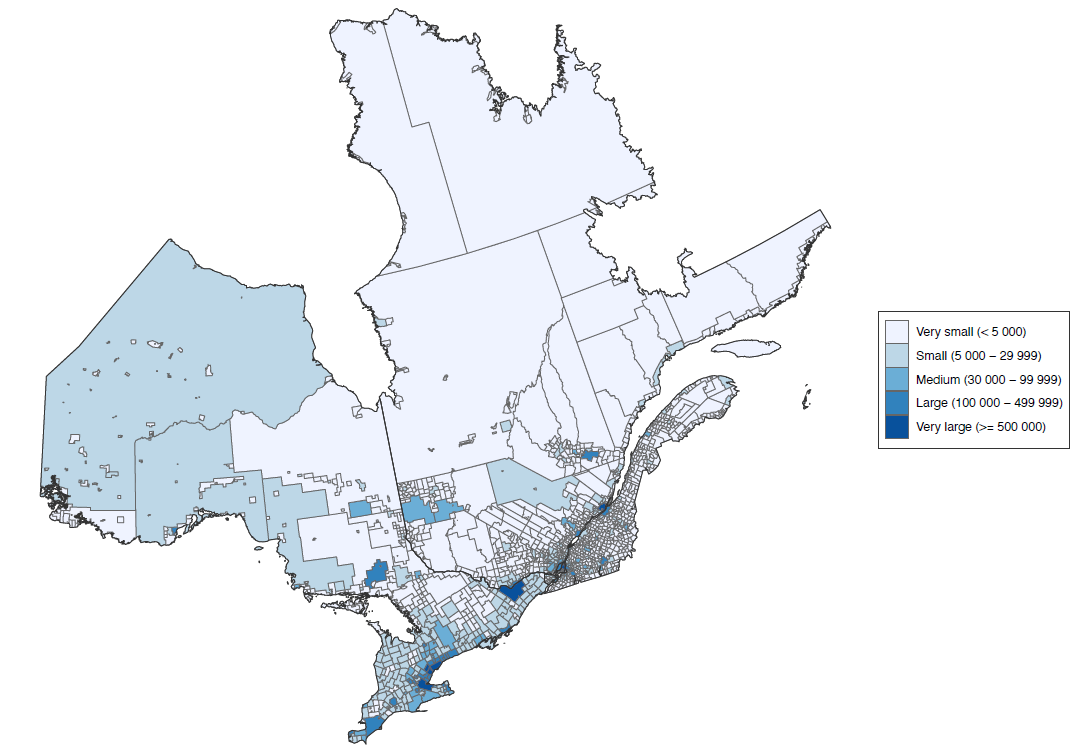
Source: Statistics Canada. Table 17-10-0155-01 Population estimates, July 1, by census subdivision, 2021 boundaries
Figure 2.3 long description (click here to view)
Communities by size, Central Canada, 2024
Size | Number of Census Subdivisions (CSDs) | Population |
Very small communities (less than 5,000) | 1427 (76.8%) | 1,731,973 (6.9%) |
Small communities (5,000–30,000) | 327 (17.6%) | 4,029,842 (16.0%) |
Medium communities (30,000–100,000) | 64 (3.4%) | 3,421,213 (13.6%) |
Large communities (100,000–500,000) | 34 (1.8%) | 6,827,583 (27.1%) |
Very large communities (more than 500,000) | 7 (0.4%) | 9,169,549 (36.4%) |
Total | 1,859 (100%) | 25,180,160 (100%) |
In 25 years, if land use and consumption patterns remain the same, Central Canada might need:[xxxvi]
- Housing: 10.1 million to 13.0 million housing units (9.2 million units in 2021);
- Clean water: 3.3 to 4.2 billion cubic metres of drinking water (3.0 billion in 2021);
- Wastewater: 4.4 to 5.6 billion cubic metres of wastewater (4.2 billion in 2023);
- Waste disposal: 18.0 to 23.2 million tonnes of solid waste sent to landfills or incinerators (16.6 million in 2022);
- Waste diversion: 6.6 to 8.4 million more tonnes of solid waste diverted from landfills or incinerators (6.1 million in 2022);
- Vehicles: 15.4 to 19.7 million vehicles on the road (14.7 million in 2023);
- Public transit: 1.3 billion to 1.7 billion trips taken on public transit (1.2 billion in 2023); and,
- Active transportation: 580,000 to 750,000 people primarily walking, running or cycling to work (557,000 in 2023).
Central Canada will likely need to increase its infrastructure capacity to support more housing, while navigating increasing climate hazards and replacing or repairing infrastructure in poor and very poor condition.
Communities in Central Canada, especially those further south, are projected to experience significant increases in extreme heat.[43] Communities are expected to see a substantial rise in the number of days with maximum temperatures above 30°C and more frequent and prolonged heatwaves.[44] Communities in this region will also face the highest increases in cooling degree days, indicating a sharp rise in energy demand for air conditioning. Increased electricity demand during peak heating days places strain on the region’s electricity grid, which could impact infrastructure systems that rely on electricity for energy, such as water treatment facilities and electric transportation.[45]
The largest communities in the region are also expected to be increasingly vulnerable to more frequent and intense rainfall events. These changes in rainfall elevate flooding risks, particularly in areas with aging or inadequate stormwater infrastructure.[46]
As infrastructure systems are interconnected and interdependent, tackling these issues in tandem is essential to avoiding major infrastructure disruptions moving forward.
Meeting population growth and climate challenges in the Prairies
The Prairies (Manitoba, Saskatchewan and Alberta) are known for their expansive flatlands, rich natural resources and agricultural productivity. The region’s combined population is around 7.6 million people, spread across an area of approximately 1.8 million square kilometres, resulting in a low population density of about 4.4 people per square kilometre. While larger communities like Calgary, Edmonton, Winnipeg and Saskatoon are growing rapidly, much of the land remains rural and agricultural. The region’s very small (1,476) and small communities (115) together represent nearly 96% of land and 31% of the population (2024), while the medium (16), large (5) and very large (3) communities hold 69% of the population on 4% of the land.[xxxvii] Based on the 2021 Census, there are 709,545 Indigenous peoples (First Nations 57%, Métis 40%, Inuit 1% and others 2%) living in the Prairies, representing almost 40% of the Indigenous population in Canada.
The Prairies are expected to have the highest population growth in the country by 2049 with average increases ranging from 17% under the low-growth scenario to 49% under the high-growth scenario.[xxxviii] Growth projections vary by community size. Under the low-growth scenario, very small and small communities are expected to shrink by 14% and 3%, respectively.[xxxix] Medium, large and very large communities are projected to grow by 10%, 19% and 35%, respectively. Under the high-growth scenario, growth is substantially higher across all community sizes, with very small communities expected to grow by 11%, small communities by 23%, medium communities by 38%, and large and very large communities by 52% and 71%, respectively.
Figure 2.4: The Prairies are marked by larger and vibrant communities, but most of the land remains lightly populated.
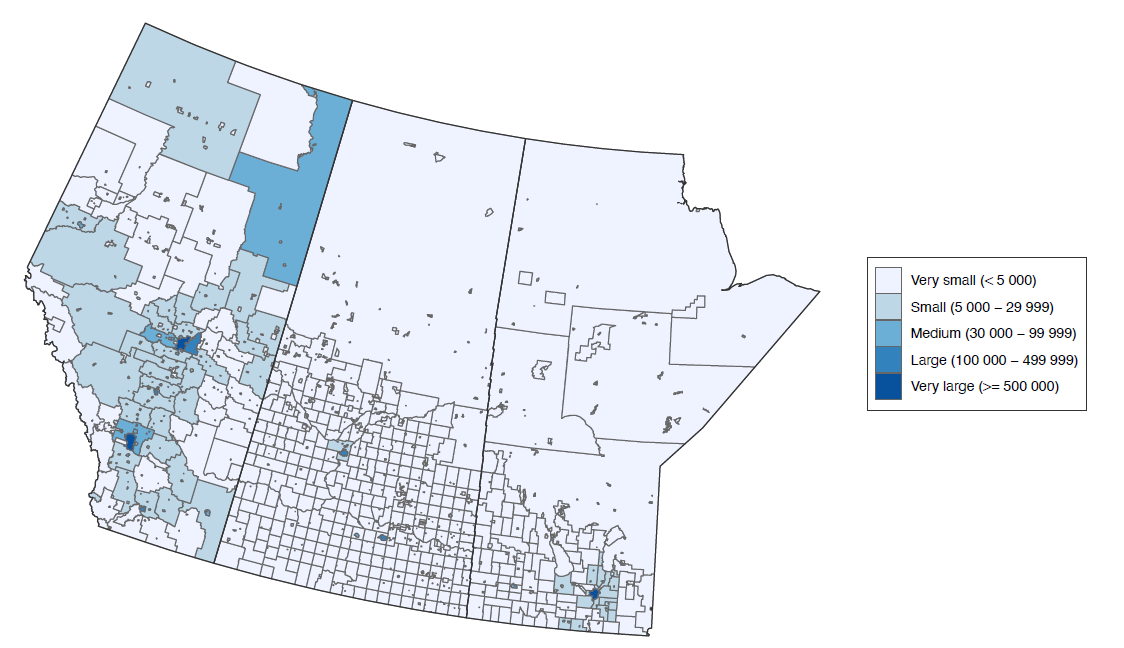
Source: Statistics Canada. Table 17-10-0155-01 Population estimates, July 1, by census subdivision, 2021 boundaries
Figure 2.4 long description (click here to view)
Communities by size, Prairies, 2024
Size | Number of Census Subdivisions (CSDs) | Population |
Very small communities (less than 5,000) | 1,476 (91.5%) | 1,099,662 (14.4%) |
Small communities (5,000–30,000) | 115 (7.1%) | 1,280,569 (16.8%) |
Medium communities (30,000–100,000) | 14 (0.9%) | 745,871 (9.8%) |
Large communities (100,000–500,000) | 5 (0.3%) | 893,556 (11.7%) |
Very large communities (more than 500,000) | 3 (0.2%) | 3,603,231 (47.3%) |
Total | 1,613 (100%) | 7,622,889 (100%) |
In 25 years, if land use and consumption patterns remain the same, the Prairies might need:[xl]
- Housing: 3.3 to 4.2 million housing units (2.6 million units in 2021);
- Clean water: 915 million to 1.2 billion cubic metres of drinking water (709 million in 2021);
- Wastewater: 763 to 969 million cubic metres of wastewater (626 million in 2023);
- Waste disposal: 7.3 to 9.3 million tonnes of solid waste sent to landfills or incinerators (5.7 million in 2022);
- Waste diversion: 1.8 to 2.2 million tonnes of solid waste diverted from landfills or incinerators (1.4 million in 2022);
- Vehicles: 6.7 to 8.5 million vehicles on the road (5.5 million in 2023);
- Public transit: 273 to 345 million trips taken on public transit (221 million in 2023); and,
- Active transportation: 170,000 to 217,000 people primarily walking, running or cycling to work (144,000 in 2023).
The Prairie provinces will most likely need to scale up their infrastructure capacity to replace aging infrastructure and accommodate potential population growth as well as significant changes in average temperature and precipitation.
Temperature and precipitation changes are increasing the severity and frequency of flooding and drought, threatening infrastructure and water resources and making water management more difficult.[47] This poses significant challenges to infrastructure, including stormwater systems, and is deeply affecting key sectors like agriculture. The region is also increasingly experiencing more severe and frequent wildfires, which place infrastructure systems at risk.
Building resiliency in the West
British Columbia consists of diverse geography, ranging from coastal rainforests to interior mountains. In 2024, about 5.7 million people lived on a land area of roughly 921,000 square kilometres, yielding a population density of around six people per square kilometre. The population is heavily concentrated in the Lower Mainland, particularly in and around Vancouver.[xli] Based on the 2021 Census, there are 290,210 Indigenous peoples (First Nations 62%, Métis 34%, Inuit 1% and others 4%) living in the province, representing almost 6% of the province’s total population.
The population of British Columbia is projected to grow by 7% to 41% by 2049 under the low- and high-growth scenarios, respectively.[xlii] As in the other regions, growth is expected to be concentrated in the largest communities, with very large communities projected to increase by 16% to 54%, large communities by 11% to 46% and medium communities by 6% to 39%.[xliii] Under a low-growth scenario, very small and small communities may decline by 13% and 8%, respectively. Under a high-growth scenario, small communities could grow by 19%, while very small communities could grow by 11%.
Figure 2.5: Western Canada combines larger, coastal communities with smaller communities in the interior
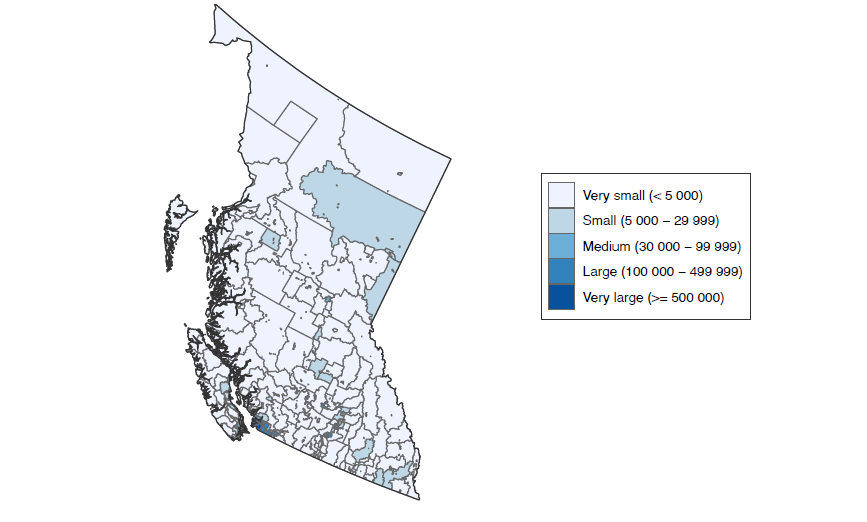
Source: Statistics Canada. Table 17-10-0155-01 Population estimates, July 1, by census subdivision, 2021 boundaries. 2025.
Figure 2.5 long description (click here to view)
Communities by size, Western Coast, 2024,
Size | Number of Census Subdivisions (CSDs) | Population |
Very small communities (less than 5,000) | 643 (85.6%) | 525,381 (9.2%) |
Small communities (5,000–30,000) | 77 (10.3%) | 842,038 (14.8%) |
Medium communities (30,000–100,000) | 16 (2.1%) | 873,196 (15.3%) |
Large communities (100,000–500,000) | 13 (1.7%) | 2,001,348 (35.1%) |
Very large communities (more than 500,000) | 2 (0.3%) | 1,456,467 (25.6%) |
Total | 751 (100%) | 5,698,430 (100%) |
In 25 years, if land use and consumption patterns remain the same, Western Canada might need:[xliv]
- Housing: 2.4 to 3.1 million housing units (2.0 million units in 2021);
- Clean water: 939 million to 1.2 billion cubic metres of drinking water (807 million in 2021);
- Wastewater: 683 to 896 million cubic metres of wastewater (621 million in 2023);
- Waste disposal: 3.2 to 4.2 million tonnes of solid waste sent to landfills or incinerators (2.8 million in 2022);
- Waste diversion: 2.0 to 2.6 million tonnes of solid waste diverted from landfills or incinerators (1.8 million in 2022);
- Vehicles: 4.0 to 5.3 million vehicles on the road (3.7 million in 2023);
- Public transit: 312 million to 409 million trips taken on public transit (284 million in 2023); and,
- Active transportation: 197,000 to 258,000 people primarily walking, running or cycling to work (179,000 in 2023).
Based on potential population growth, current infrastructure conditions and a changing climate, the West will need to add housing-enabling infrastructure, and upgrade existing infrastructure to be resilient to climate hazards.
The West faces significant threats from climate hazards, most notably extreme heat events, wildfires, drought and flooding, with both the severity and frequency of these events expected to increase in a changing climate.[48] The region is projected to see more severe and frequent floods and landslides.[49] These events can damage buildings and disrupt transportation, creating challenges for mobility infrastructure specifically, as well as for water and solid waste management assets. This could cause challenges for water management. Floods contaminate freshwater sources and snowpack melt is diminished due to warmer winters, which, along with droughts, lead to less water in reservoirs.[50] Total precipitation may also decline in some years, particularly in the interior of the province.[51]
Navigating change in northern realities
The Territories, including Yukon, Northwest Territories, and Nunavut, encompass the most remote and sparsely populated parts of Canada. This northern region also covers a vast land area of over 3.4 million square kilometres (more than a third of Canada’s total landmass), but is home to only around 130,000 people, resulting in an extremely low population density of about 0.04 people per square kilometre. Based on the 2021 Census, 60,235 Indigenous peoples (First Nations 32%, Métis 7%, Inuit 59% and others 2%) live in the territories, representing almost half of the total population. About 86% of Nunavut’s population identifies as Inuit.
Though all three territories do not have large communities, they follow the same trend as other regions, with their population being concentrated in a relatively small area. Iqaluit, Whitehorse and Yellowknife represent 0.02% of land and 48% of the population, the rest of which is distributed among the 104 very small communities of under 5,000 people.[xlv] Under a medium-growth scenario, the very small communities may decline (-3%), while growth will be split between small communities (23%) and Whitehorse (29%), graduating the latter to the medium community category. [xlvi]
Figure 2.6: Characterized by their remoteness, Northern Canada’s communities are sparse and widely dispersed

Source: Statistics Canada. Table 17-10-0155-01 Population estimates, July 1, by census subdivision, 2021 boundaries. 2025.
Figure 2.6 long description (click here to view)
Communities by size, Terriroties, 2024
Size | Number of Census Subdivisions (CSDs) | Population |
Very small communities (less than 5,000) | 104 (97.2%) | 62,150 (52.2%) |
Small communities (5,000–30,000) | 2 (1.9%) | 30,216 (22.8%) |
Medium communities (30,000–100,000) | 1 (0.9%) | 33,228 (25.1%) |
Large communities (100,000–500,000) | N/A | N/A |
Very large communities (more than 500,000) | N/A | N/A |
Total | 107 (100%) | 132,594 (100%) |
In 25 years, if land use and consumption patterns remain the same, the North might need: [xlvii]
- Housing: 45,000 to 56,000 housing units (42,000 units in 2021);
- Clean water: 16.2 to 20.0 million cubic metres of drinking water (15.1 million in 2021);
- Wastewater: 5.1 to 6.2 million cubic metres of wastewater (4.6 million in 2023 in the Yukon);
- Waste disposal: 98,000 to 115,000 tonnes of solid waste sent to landfills or incinerators (96,000 in 2020);
- Waste diversion: 31,000 to 38,000 tonnes of solid waste diverted from landfills or incinerators (29,000 in 2020);
- Vehicles: 79,000 to 97,000 vehicles on the road (76,000 in 2023); and,
- Public Transit: 970,000 to 1.2 million trips taken on public transit (910,000 in 2023).
Water infrastructure in the North is uniquely adapted to extreme cold and permafrost, often using above-ground and insulated systems with simpler treatment facilities and logistical solutions like water truck delivery. For example, mechanical water treatment plants are more difficult to operate in the North, making lagoons and overland treatment more ideal. These adaptations contrast with the more integrated and underground water systems common in southern Canada.
Climate change has, and will continue to have, the greatest impact on average temperatures in the North. Annual mean temperature over Northern Canada increased by 2.3°C (likely range 1.7°C to 3.0°C) from 1948 to 2016, or roughly three times the global mean warming rate.[52] Many buildings and infrastructure are built atop permafrost. When permafrost thaws, the soil, gravel and sand that was once frozen can shift, slump and slide. This can significantly damage roads, buildings and infrastructure that rely on the permafrost as a natural foundation.[53] When permafrost thaws beneath a building, the floors and walls can shift and crack, and roads may develop sink holes or become uneven. In addition to having direct impacts on infrastructure and communities, permafrost thaw disrupts northern ecosystems and landscapes, with dramatic impacts to people who harvest and live on the land.[54]
The infrastructure realities faced in the territories are also experienced in Nunatsiavut (Newfoundland and Labrador) and Nunavik (Quebec).
More informed planning starts with improved data accessibility
While existing data can provide an illustration of the growing gap between housing development and infrastructure capacity over the next 25 years, much remains unknown. Infrastructure data in Canada is fragmented, inconsistent, of varying quality and not always publicly accessible. This can constrain the ability of all orders of government to effectively assess and plan for the long term.
Enabling decision-makers to project what infrastructure may need to be maintained, improved and/or built means moving from simple service demand projections to understanding service usage and existing infrastructure capacity at the local level.
As a priority, better and more publicly available data on the existing capacity of infrastructure facilities and service usage levels is needed to support better planning at the federal, regional, municipal and local levels.
Chapter 3: Navigating Pressures in Infrastructure Planning and Delivery
| CHAPTER SUMMARY |
|---|
| Canada’s infrastructure planning faces mounting challenges due to a complex regulatory environment, costs (e.g., labour, material and capital), local concerns and economic pressures, including rapidly changing global economic conditions. Labour shortages, especially in construction, and supply chain disruptions further strain timelines, particularly in remote regions. Municipalities struggle with limited, unpredictable funding compared to the scale of infrastructure responsibilities, and rely heavily on property taxes, user fees, development charges and government funding. Innovative financing tools and private sector investment offer potential but remain underutilized. Addressing these pressures will require streamlined governance, more predictable investment and project pipelines, workforce development and diversified funding to build infrastructure that meets future needs. |
Building infrastructure in Canada is a complex, long-term, capital-intensive process that involves numerous challenges. These include economic and social pressures from permit delivery to material shortages that can lead to cost overruns, project delays and service disruptions, ultimately impacting communities and the economy. Additionally, future climate risks demand building increased resilience into new projects and existing infrastructure. It is critical that decision-makers overcome these challenges to ensure that infrastructure systems can meet current and future needs.
Figure 3.1. Navigating the housing-enabling infrastructure journey from policy to home

Figure 3.1 long description (click here to view)
Navigating the housing-enabling infrastructure journey from policy to home
The housing enabling infrastructure journey is comprised of the following steps:
1. Planning and Policies
Create projects using ongoing process of community planning (for example, land use and asset management, climate adaptation and asset specific planning). Step 1 includes participation from local government, provincial and territorial government, engineers, architects and inspectors, and quantity surveyors, accountants, economics and modelers.
2. Project Management & Design
Develop a business case to demonstrate the need, cost, benefits, risks and other considerations. Step 2 includes participation from local government, and engineers, architects and inspectors.
3. Financing
Exploring and gaining access to financial options and business models. Step 3 includes participation from Federal government, provincial and territorial government, local government, private financial partners, engineers, architects and inspectors, and quantity surveyors, accountants, economics and modelers. Note, projects that fail to meet the objectives of steps 2 and 3 require the process to restart.
4. Pre-Development Work
Demonstrate feasibility and capacity, create partnerships with governments, and define the project further (for example, plant capacity). Step 4 includes participation from Federal government, provincial and territorial government, local government, private financial partners, and engineers, architects and inspectors.
5. Procurement
Community reaches an agreement with a private partner and/or award contracts to contractors. Step 5 includes participation from local government, trades and private construction firms, and private financial partners.
6. Preconstruction planning
Community reaches an agreement with a private partner and/or award contracts to contractors. Step 6 includes participation from Federal government, provincial and territorial government, local government, trades and private construction firms, private financial partners, engineers, architects and inspectors, and surveyors, environmental and other specialists.
7. Construction
Building the asset and installing systems. Step 7 includes participation from trades and private construction firms, engineers, architects and inspectors, and surveyors, environmental and other specialists.
8. Commissioning
Begin offering service to the public in adhering to operations manuals, including monitoring and reporting (for example, emissions). Step 8 includes participation from local government, trades and private construction firms, engineers, architects and inspectors, and private financial partners.
9. Operation & Maintenance
Provide the service and maintenance of the asset (for example, water source management and quality monitoring). Step 9 includes participation from local government, trades and private construction firms, engineers, architects and inspectors, and private financial partners.
10. Closure & Post Closure
Site monitoring for environmental compliance. Step 10 includes participation from Federal government, provincial and territorial government, local government, private financial partners, trades and private construction firms, and engineers, architects and inspectors.
Navigating market pressures
Supply chain disruptions, labour shortages and uncertain financing are converging to delay projects, increase costs and reduce the reliability of delivery timelines. This pressure is not temporary. To build for the future, we must address not only what infrastructure is needed, but also how it can be built under current and persisting economic pressures.
Supply chain disruptions delay materials
Supply chain issues have the potential to increase costs and delay construction of new infrastructure projects. In recent decades, supply chains have been extended with steps to produce final products spread across international borders and over greater distances. Construction uses intermediate inputs, like steel or cement, to build infrastructure. The more refined a product is, the more there are steps needed to produce it and borders to cross, which increases the risk of supply chain disruptions. Supply chain vulnerability will differ by infrastructure project depending on geography and the source of required components. Trade disruptions resulting from recent US trade policies are leading to delays in the movement of goods across borders, increasing costs for raw materials and components and creating uncertainty for the construction sector, particularly where it relies on integrated North American supply chains.
In Northern Canada, supply chains are a persistent challenge. The lack of year-round road access to many northern communities means that goods often need to be transported by air, seasonal sea lifts and ice roads. These modes are subject to weather conditions, are more costly and can impact delivery timelines. Many northern communities lack the infrastructure, like ports, railways or extensive road networks, that would enable efficient supply chain operations. This makes the region more dependent on more expensive and carbon-intensive air freight shipping, which is less reliable, especially in the winter months. These challenges highlight the need to explore more regionally tailored solutions moving forward, such as alternative building methods and materials.
Workforce gaps in construction delay new projects
Canada’s construction industry is experiencing significant labour shortages with an aging workforce and high demand for skilled tradespeople for housing, infrastructure and industrial projects across the country, coupled with flat or declining enrollment in vital professional services and trades. As of 2024, 20% of the construction workforce was aged 55 or over compared with 13% 20 years ago.[xlviii] Buildforce Canada estimates that Canada will need 380,000 new construction workers by 2034 to meet demand and replace retiring workers.[55] Current projections estimate that Canada will face a shortfall of more than 108,000 workers in spite of heightened recruitment levels.
Atlantic Canada has the highest share of construction workers aged 55 or over and is likely to see more retirements than other parts of the country. In contrast, Prairie provinces have the lowest percentage of construction employment over the age of 55. Despite the labour shortfall, the number of certificates granted to apprentices in Red Seal trades in the construction industry has remained flat since peaking in the early 2010s for most trades, including construction electricians, carpenters and welders.[xlix] However, recent immigrants, women and Indigenous peoples face unique barriers to participation in apprenticeship training which is likely suppressing the number of certificates granted.[56]
Labour shortages are particularly acute in Northern Canada, where chronic housing needs prevent migration of construction workers to the communities that need them most.[57] This creates a cycle where insufficient housing prevents the migration of workers needed to build the housing and infrastructure necessary to meet emerging housing needs.
In 2022, Canada’s accredited engineering schools had 85,113 undergraduate and 30,271 postgraduate students.[58] Since 2017, enrollment has grown modestly (+3% at the undergraduate level and +26% at the graduate level). Engineering fields relevant to construction (civil, environmental, geological, mining and material/metallurgical) only accounted for 18.9% of all students. International students made up 18.1% of total undergraduate enrollment in engineering programs in 2022. Recent immigration caps have reduced the intake of new international students in Canadian universities. If the caps persist over time, then they may deepen Canada’s engineering workforce shortages as only about 16,000 to 18,000 engineers graduate annually from Canadian programs.[59]
While labour supply challenges limit Canada’s ability to build new infrastructure, automation and artificial intelligence (AI) present opportunities to offset the effects of this trend by automating some functions and increasing productivity.[60] For example, prefabrication, or projects where components are manufactured offsite and assembled on location, could decrease construction timelines and reduce costs due to their production line nature. AI-powered Building Information Modelling (BIM) could also be integrated with prefabricated construction methods to ensure that components are accurately designed and will fit together seamlessly during on-site assembly.[61]
Navigating financial pressures
While most housing-enabling infrastructure is owned by local governments,[l] these governments have limited revenue tools and access to capital markets.[62] Housing-enabling infrastructure in Canada is traditionally funded through capital spending, which draws from a mix of debt, reserves, government funding (e.g., grants) and user fees. While a part of operating revenue, property taxes account for the largest share of local government revenue (45% in 2023).[li] In some cases capital spending is funded through dedicated property taxes and reserves. Property taxes are the most stable and predictable revenue source, but are also tied to property values and politically sensitive to increase. In some jurisdictions, development charges to finance the infrastructure needed to support new housing have been rising significantly.[63] Research has shown that funding infrastructure through property taxes and development charges has significant impacts on the cost of new homes.[64]
While user fees (e.g., for water and transit services) can support cost recovery and repairs and maintenance, at current levels they are insufficient for financing major capital expansion. Strategically designed user-fees can incentivize efficient service usage while managing infrastructure demand, such as charging for consumption of a commodity, like water or roads, combined with a fixed cost of service provision.[65] A stable revenue stream from user fees can also in turn be used to leverage additional private financing; for example revenues from a toll road or resource recovery from a wastewater treatment facility.
A number of interest holders noted that when governments provide predictable, long-term funding that is focused on desired outcomes, rather than overly prescribing specific activities or project parameters, recipients are more willing to accept conditions attached to that funding. By combining predictability with flexibility and conditionality, governments can specify the desired outcomes while empowering communities to determine the best ways to achieve them. It can also make it easier for the construction sector to plan the resources needed to deliver infrastructure as labour supply is particularly dependent on predictable workflow to attract and retain talent.
Indigenous communities are facing additional financial pressures as funding infrastructure projects is different for their communities. Indigenous governments and entities often face legal barriers and higher borrowing rates due to the misperception of greater risk.[66] These pressures may impact First Nations, Inuit, and Métis communities differently due to their unique legal and governance distinctions. Indigenous financial institutions have emerged to fill this gap, such as the First Nations Finance Authority.[67]
From green bonds to blended finance
Some communities are turning to innovative financing instruments to expand their fiscal toolkit. Green bonds are increasingly used to fund environmentally sustainable infrastructure, appealing to investors mindful of environmental, social, and governance (ESG) criteria.[68] Several provinces have adopted tax increment financing to leverage future property tax revenues from development to finance upfront costs of enabling infrastructure.[69] Pooled borrowing authorities, like the Municipal Finance Authority of British Columbia, allow smaller municipalities to access capital markets at lower rates.[70] While promising, such tools remain underutilized across the country due to regulatory barriers, administrative complexity and limited technical capacity in many jurisdictions.[71],[72]
Attracting private sector capital to finance infrastructure projects is increasingly essential given the growing constraints on public resources. For example, blended finance can be used to allow public and private capital to work together to address investment barriers while achieving their objectives. By leveraging private investment, public entities can accelerate project delivery, share financial risks and tap into private sector expertise and innovation. Catalyzing private investment not only expands the pool of available funding for infrastructure projects, but also allows public funding to be strategically focused on areas where private financing is not viable, such as where the financial return does not justify the investment risk.
Navigating local pressures
Infrastructure planning and the regulatory environment in Canada is a complex, multi-tiered process involving federal, provincial/territorial and municipal governments, each with distinct responsibilities and powers. Policy cohesion, governance and regulatory processes play a critical role in shaping and enabling appropriate infrastructure projects. These processes, which include planning, approval, environmental and archaeological assessments, stakeholder consultations and regulatory compliance, are intended to ensure that built infrastructure contributes positively to communities. However, when applied in aggregate, they may result in vital projects not being built.
Navigating local concerns on infrastructure development
Project implementation can encounter local opposition, or NIMBYism (Not In My Backyard) sentiments. This typically arises when local residents object to development near their homes due to concerns about change, noise, traffic, environmental impacts and/or perceived declines in property value. While citizen engagement is essential to democratic planning, strong local NIMBY attitudes can sometimes delay or derail projects that offer broader societal benefits, such as affordable housing or expanded public transit. This opposition can delay timelines, inflate costs, result in bad decisions, and relocate projects to less suitable locations in terms of public benefits.[73]
Regulatory processes contribute to project delays and cost escalation
The length of time it takes to complete the regulatory steps needed to build a project has direct implications for its final cost and on whether it proceeds at all. Project delivery delays impact costs since the longer a project takes, the greater the uncertainty is around the completion date. Though regulatory processes are not the sole contributor to extending timelines, extended timelines have been shown to increase risks and costs.[74],[75]
Chapter 4: Planning for Resilient and Liveable Communities
| CHAPTER SUMMARY |
|---|
| This chapter highlights the need to prioritize urban density over suburban sprawl to reduce the need for new infrastructure, minimize the liability associated with maintaining new infrastructure and improve service efficiency. While downtown areas are growing, most development still occurs in distant suburbs, driving up infrastructure expansion needs and placing greater strain on existing systems. Denser communities support more cost-effective public transit and infrastructure delivery. In contrast, sprawling suburbs limit efficiency and accessibility, increase costs and contribute to a growing maintenance burden for municipalities already facing infrastructure operating deficits and significant deferred maintenance. Natural assets, like wetlands and upland forests, offer infrastructure services that remain underrecognized and undervalued financially, while nature-based infrastructure solutions, such as wetlands, are also underutilized. Green spaces provide a range of ecosystem services that support the well-being of people, including physical and mental health and climate resilience, especially in or near densely populated urban areas. Climate-resilient infrastructure and proactive asset management planning for built and natural assets are essential to prepare for future risks and minimize long-term costs. |
Addressing the increasing pressure on Canada’s infrastructure, driven by aging systems, population growth and climate change, requires a shift from traditional, siloed approaches to more integrated, sustainable strategies. Thoughtful land use planning, investment in natural infrastructure, urban densification and creating inclusive public spaces can collectively offer innovative, cost-effective and resilient solutions to aging infrastructure, escalating housing and transportation costs and increased exposure of housing-enabling infrastructure to climate hazards. By aligning infrastructure development with environmental and social priorities, Canada can build communities that are not only more efficient and livable, but also better equipped to adapt to future demands and the impacts of climate change.
Prioritizing building through density over suburban sprawl
Canadian cities are becoming denser, but suburban sprawl persists as a dominant trend. From 2016 to 2021, downtown cores in large urban centres experienced notable population growth (+10.9%), surpassing the overall urban growth rate (+6.1%).[lii] However, more distant suburbs (30+ minutes from downtown) grew at a faster pace (+8.8%) than suburban areas closer to downtown (+5.8%) or the urban fringe (10 minutes from downtown, +3.7%).[liii] Despite rapid growth in downtown populations, these areas only accounted for 4.7% of Census Metropolitan Area residents in 2021, whereas the outlying suburbs continued to dominate housing development, representing 23.8% of residents.[liv]
To minimize the cost of new infrastructure builds and maintenance, development should be encouraged in areas where infrastructure already exists. Densifying existing urban areas optimizes infrastructure efficiency and reduces long-term costs.
Higher population density levels can reduce the cost to deliver infrastructure services per household due to economies of scale. It can cost over three times more to provide community mobility and water and sanitation infrastructure services to low-density suburban areas than it does in high-density urban neighbourhoods.[76] Greater population density improves infrastructure efficiency by enabling more homes to be serviced within the same network footprint. While linear infrastructure (e.g., roads and pipes) may increase in width, the overall infrastructure required per household decreases, which in turn lowers the average service cost.
Public transit and active transportation infrastructure are most impacted by the density of both housing and amenities. Greater population density increases the need for public transit and active transportation as limited road space leads to congestion during peak travel hours. Population density also diversifies the viable types of public transit, such as Light Rail Transit (LRT) and Bus Rapid Transit (BRT) systems, as increased ridership makes more advanced transit options operationally feasible. Similarly, mixed-use, more densely populated neighbourhoods make active transportation more convenient as homes are within walking and cycling distance of amenities. A 2018 study of public transit ridership in Canada found that ridership was positively associated with apartment buildings and rowhouses and negatively associated with single-family detached homes.[77] In this way, there is a positive feedback loop between public transit and active transportation with population density whereby higher density increases the need for public transit and active transportation while also making those systems faster, more reliable and financially sustainable.
The interplay between population density, infrastructure development and community mobility is critical to tackling Canada’s housing and resource management challenges. Prioritizing urban densification and optimizing existing infrastructure systems can minimize costs, improve service delivery and enhance public transit and active transportation systems. Infrastructure and land-use planning can reduce vehicle use, improving public health and reducing greenhouse gas emissions.[78], [79] Tailored policies that consider the specific needs of urban centres and remote communities are vital for ensuring equitable access to resources and opportunities. This comprehensive approach will foster sustainable growth and economic development across the country.
Natural infrastructure and nature-based solutions provide cost-effective, multi-benefit results
Nature-based solutions may restore or enhance natural systems or involve constructing enhanced assets, providing mutual benefits to people and nature. Natural infrastructure, often referred to as natural assets, refers to the stock of ecosystems or natural resources, such as wetlands, aquifers and rivers, that contribute to the provision of one or more services required for the well-being and long-term sustainability of a community and its residents.
Natural assets are part of the broader category of green infrastructure, along with enhanced and engineered elements that are created to mimic natural functions and processes. Natural infrastructure reduces stress on built infrastructure systems and provides additional co-benefits like improved air quality, carbon storage and mental well-being.[80]
Natural infrastructure can address multiple policy objectives simultaneously. Increased use of vegetative technologies (i.e., the use of living plants and plant-based systems to address engineering, environmental or land management challenges) can improve air quality in urban environments by absorbing air pollution, cooling neighbourhoods and managing rainwater where it falls.[81] It can also create more attractive community spaces by bringing nature into urban areas and providing attractive features that improve the aesthetics of a streetscape or parking lot. At scale, it can contribute to carbon sequestration and support biodiversity as well.[82] Further, natural infrastructure is often more cost-effective to build and maintain (by up to 50%) relative to traditional grey (i.e., engineered) infrastructure, while delivering equivalent services.[83]
Despite these benefits, natural infrastructure is not yet considered the default option for most infrastructure projects.[84] This can be attributed to several barriers, such as lack of recognition of natural assets and the services they provide in asset management planning and financial reporting,[85] limited familiarity in designing nature-based solutions, and economic appraisals that are not based on the full range of ecosystem services and co-benefits.[86]
Attracting private sector investment for natural infrastructure is also more challenging than for grey infrastructure. Globally, the private sector accounted for only 14% of investment in nature-based solutions in 2021.[87]
Green public spaces boost health and resiliency
Green public spaces integrate both natural and built infrastructure. Those public spaces promote health and well-being by encouraging access to nature for mental health and relaxation, enabling physical activity, and fostering community cohesion spaces. They also enhance environments and human health by reducing noise, providing shade, cooling areas and minimizing flooding and air pollution risks.[88]
“Sponge parks” are an example of a form of natural infrastructure that also functions as a green public space. These multifunctional green spaces are designed to absorb, filter and manage stormwater runoff, while also providing recreational and aesthetic benefits to communities. By incorporating features such as permeable pavements, rain gardens, bioswales and native vegetation, sponge parks help reduce flooding, improve water quality and mitigate the urban heat island effect.[89] Beyond their environmental function, they also create accessible public spaces that enhance neighbourhood livability, promote physical activity and improve mental well-being, especially in densely built areas with limited green space.[90]
Climate-resilient infrastructure pays off
In 2019, the Council of Canadian Academies identified infrastructure as one of the top sectors at risk from climate impacts in Canada.[91] Most of Canada’s existing infrastructure was built under the assumption that the climate was stable, according to guidelines and specifications for climate conditions that no longer exist. Permissive land use policies continue to allow, and in some cases incentivize, housing and assets to be built in known high-hazard areas.[92]
These approaches are now outdated, as the impacts of climate change and natural hazards are increasing in frequency and intensity across Canada, with significant loss and damage. Analysis from the Financial Accountability Office of Ontario (FAO) indicates that without adaptation, annual climate-related infrastructure costs could increase by $4.1 billion under a medium greenhouse gas emissions scenario or $7.4 billion under a high-emissions scenario by 2100.[93] The most effective way to minimize the costs of recovery and rebuilding post-disaster is to invest in proactive adaptation measures. The Canadian Climate Institute estimates that every $1 spent today on key adaptations can result in $13-$15 in direct and indirect savings and benefits on an economic basis.[94] Investing in communities’ climate resilience increases their ability to withstand unpredictable future extreme weather and hazard events, ultimately reducing, and potentially eliminating, the costs of rebuilding. Communities served by climate-resilient infrastructure also help protect residents from high insurance premiums by reducing the risks and potential costs associated with damage from extreme weather events.
Helping communities mitigate and adapt to changing natural hazards ultimately results in reduced costs for taxpayers, businesses and governments. Codes and standards can define design and operation requirements throughout the lifecycle of climate-resilient infrastructure and buildings, from design, construction and operation to rehabilitation or decommissioning. Clear and consistent standards are essential to managing risk, ensuring quality and enabling innovation. They can also enable a more predictable climate for infrastructure investment by reducing uncertainty.
While smaller communities often lack capacity to plan for climate resilience, they have a strong connection to the local environment, especially Indigenous communities. Place-based knowledge systems, including local and Indigenous knowledge and lived experience, are key to understanding and adapting to climate change impacts and can complement scientific and technical approaches to building climate resilience.[95],[96]
While climate-resilient infrastructure offers significant community and regional benefits, private investors may be dissuaded from investing in this type of infrastructure for the same reasons they are not investing in natural or green infrastructure, as noted earlier.
Strengthening infrastructure through smarter asset management
Mitigating infrastructure asset risks by better managing existing systems will be critical to meeting future needs while minimizing costs. Asset management planning can help communities track the condition and age of water pipes, stormwater drains and other built infrastructure, as well as natural assets like wetlands and groundwater sources (e.g., aquifers). This allows for proactive management, maintenance and repair before problems, like leaks or drinking water pollution, occur. Regular inspections and timely repairs help prevent minor issues from turning into major ones.
Infrastructure asset management refers to a coordinating activity of an organization to manage physical assets and the services they provide in order to maximize the value these assets provide over their lifecycle. It covers the operating, maintenance, repair, disposal and eventual replacement of the capital asset. A central component of the process is an asset management plan (AMP), which is informed by asset condition, lifecycle maintenance, financial needs and service levels, as well as factors like population growth and climate resilience. Currently in Canada the approach to asset management planning is not being done in a consistent way, making information sharing difficult. Existing standards can provide a useful starting point for communities by defining principles, concepts and terminology to guide asset management planning, but would need to be adapted to the capacities of smaller communities.
Effectively managing infrastructure assets can reduce maintenance costs, extend asset lifecycles and ensure public safety.[97] While many infrastructure owners have documented AMPs, opportunities exist to expand and improve current practice. In 2022, less than 70% of local and regional governments in Canada reported having an AMP in place for all housing-enabling infrastructure assets (see Figure 4.2).[lv] This percentage does not include natural assets or the more than 150 communities across Canada that have started implementing natural asset management practices.[98] Natural asset management follows the same process as for built assets, including inventory, condition assessment and financial valuation.
Figure 4.2: Asset management planning by public organizations, 2022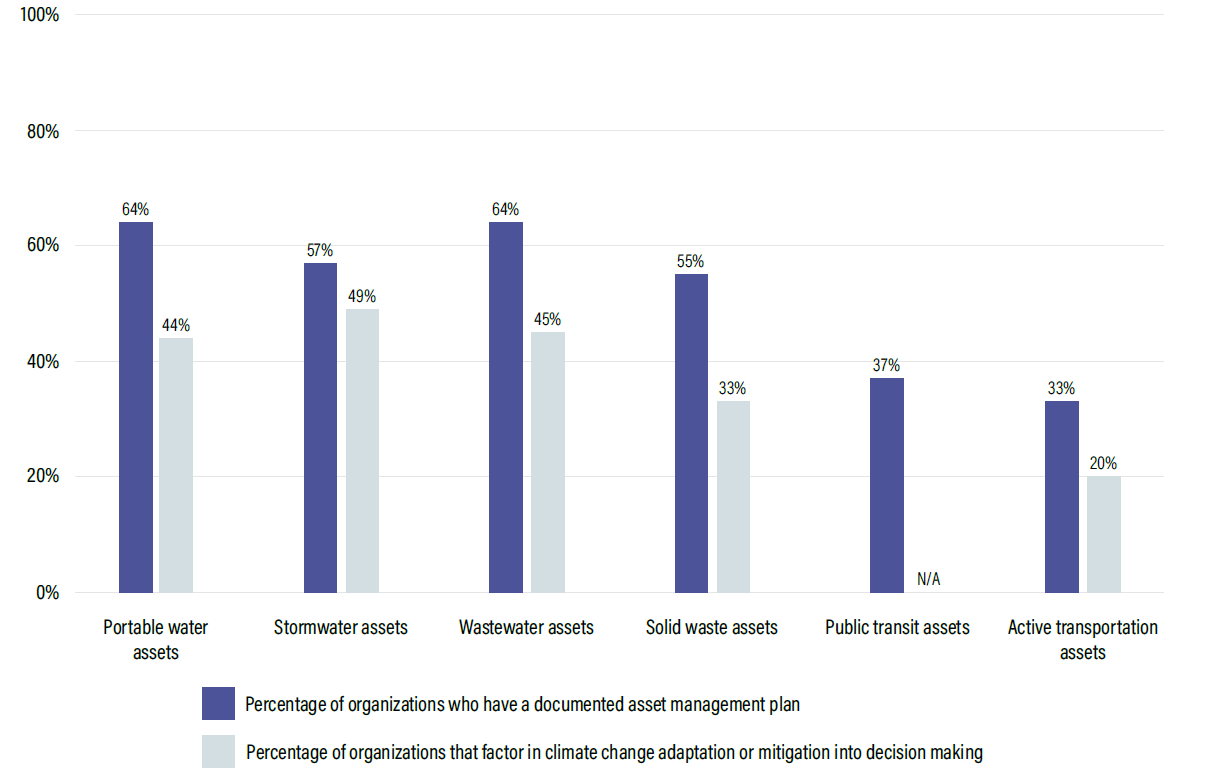 Source: Statistics Canada. Table 34-10-0290-01 Asset management practices of core public infrastructure. 2025.
Figure 4.2 long description (click here to view)
Asset Management Planning by Public Organizations in Canada
Types of Infrastructure Assets | Percentage of organizations who have a documented asset management plan | Percentage of organizations that factor in climate change adaptation or mitigation into decision making |
Potable water assets | 64% | 44% |
Stormwater assets | 57% | 49% |
Wastewater assets | 64% | 45% |
Solid waste assets | 55% | 33% |
Public transit assets | 37% | N/A |
Active transportation assets | 33% | 20% |
A higher proportion of urban communities reported having an AMP for most asset types with the exception of solid waste, which has comparable AMP adoption between rural and urban municipalities.[lvi] Smaller communities face greater challenges in preparing and updating their AMPs. Larger municipalities are also better positioned to leverage technology and specialized expertise, whereas smaller communities may be more likely to face capacity or resource difficulties. Expanding the use and benefits of AMPs will require sustained effort and smaller communities will require additional support to build capacity.
Operating and maintaining infrastructure systems effectively requires more than a plan. Sufficient financial and human resources are critical. For example, public transit systems face rising costs for labour and maintenance, while fare revenues have not fully recovered from pandemic-era declines.[99] This funding gap makes it difficult for transit agencies to maintain reliable service levels, invest in modernization and meet growing expectations for sustainable, accessible transit systems.
A lack of workers with sufficient expertise to manage complex water and wastewater systems can also be a significant issue for small communities. In First Nations communities especially, operators often work multiple roles with minimal support, receive compensation well below comparable positions in municipalities and face high turnover because conditions are difficult and future prospects scarce.[100] A lack of technical expertise to operate these systems leaves communities vulnerable to service disruptions or water quality issues.
Chapter 5: Building for What Lies Ahead
| CHAPTER SUMMARY |
|---|
| Over the next 25 years, Canada will need more housing and major infrastructure investments. Both must support a growing population and adapt to a changing climate. Larger communities will face pressure to expand, whereas smaller communities may decline while facing increasing climate risks. To meet these challenges, the Council recommends:
|
Over the next 25 years, Canada’s population is expected to grow from more than 40 million in 2024 to anywhere from 43 to 55 million, requiring additional housing of various types spread across regions and communities of all sizes, from major cities to small towns. Each will require access to clean water, wastewater and stormwater management, waste management, public transit and active transportation as well as other essential services, such as electricity, broadband, schools, parks and hospitals.
Meeting these needs will not be easy. Much of the population growth will be concentrated in large urban centres, which will require not only better use of existing infrastructure but also expanding it. At the same time, smaller communities are likely to face population decline while experiencing increasing climate hazards, like hurricanes, coastal erosion, permafrost thaw, drought and wildfires.
The infrastructure systems in Canada are broad and complex, and the world around us is changing rapidly. As the Council begins its work, establishing a shared understanding among all interest holders, from policy-makers to infrastructure operators, is key to effectively address the challenges ahead. The Council’s initial findings are not a critique of past decisions or existing policies and programs; rather, they are intended to foster collaboration and forward thinking. While this first report focussed specifically on housing-enabling infrastructure, its findings are relevant across the infrastructure landscape.
Based on our assessment and what we heard through our engagement (see Annex B), we have identified the following key insights:
- Better management and maintenance of existing infrastructure are essential to reduce risks and costs.
- Higher-density development makes more efficient use of existing infrastructure and supports green space preservation.
- Access to clean water, sanitation and public transit and active transportation remains uneven across the country.
- Infrastructure planning must reflect regional and community-specific conditions, including population and climate.
- Complex approval, regulatory layers and governance structures, together with aggregated taxes and charges, slow down housing construction.
- Labour shortages and supply chain issues are increasing costs and causing delays.
- Public funds alone are insufficient; private sector participation is crucial.
- Many infrastructure systems were designed for a stable climate and are not resilient to current and future conditions.
- Reliable, accessible data is needed to support infrastructure decision-making at all levels.
- Nature should be integrated into how we plan, design and build infrastructure.
We are at a critical crossroads where our actions today will shape the future for generations. Avoiding a growing gap between housing development and infrastructure capacity over the next 25 years and building more efficient and resilient infrastructure systems will require a different approach.
To achieve this, the Council recommends:
Recommendation #1: Make the most of our existing built and natural infrastructure before building new
With aging infrastructure, high replacement costs and constrained budgets, maximizing existing assets is critical.
Governments should have a clear understanding of the capacity of their infrastructure assets and prioritize maintenance, repairs and optimization before building new.
Canada is fortunate to have land and resources, but it is important that we use those resources effectively as no resource is infinite. Solutions that transform and manage demand will become increasingly important as we continue to manage the impacts of our changing climate and our growing population.
Opportunities to design infrastructure that solves multiple objectives at once should be leveraged to make each investment dollar work harder. For example, public spaces can be designed to maximize stormwater retention while providing social gathering places for communities and enhancing ecosystems.
Actions to be taken:
- Maximize the capacity and efficiency of existing built infrastructure through prioritized management, maintenance and upgrades.
- Enhance and preserve natural infrastructure through sustainable conservation and restoration practices.
- Implement demand management strategies (e.g., water metering, transit-oriented development, carpooling lanes, road pricing).
- Encourage multi-solving infrastructure projects (e.g., sponge parks) that deliver multiple benefits.
Recommendation #2: Strengthen coordination across all partners
Fragmented governance, regulatory complexity and restricted-use funding hinder infrastructure delivery. The changing global landscape, supply chain disruptions and domestic labour shortages also contribute the challenges. To overcome those systemic barriers and modernize Canada’s infrastructure systems, governments must actively support Canadian-made innovative practices, technologies and delivery models that enhance efficiency, strengthen resilience and deliver long-term value.
No single order of government or the private sector can tackle these challenges alone. Each brings a critical piece of the puzzle, whether it’s funding tools, planning authority, technical expertise or local knowledge. Without strong coordination, Canada risks inefficiencies, delays in project completion, duplication and missed opportunities, increasing the already high costs of infrastructure.
Coordinated action can reduce pressure, promote smarter development and help attract private investment, allowing public funds to be focused where private sector financing is not feasible. Beyond coordination, this also involves identifying and assessing regulatory, financial and environmental risks associated with development and ensuring these risks are allocated to those best equipped to manage them. This will enable more resilient investment strategies, attract private capital and better ensures that public resources are used where they are most needed.
Actions to be taken:
- Streamline regulatory frameworks across jurisdictions.
- Promote innovative made-in-Canada practices across design, procurement and delivery, focused on outcomes, inviting the use of new technologies and improved efficiency.
- Establish major infrastructure project pipelines to align capital, labour and materials.
- Mobilize private capital through predictability, shared risk and blended finance.
Recommendation #3: Build for the future with resilience and data at the forefront
Climate conditions are changing and will continue to evolve in the future. These impacts will vary across regions, and communities will differ in their capacity to adapt. To ensure the infrastructure we build today can stand the test of time, it must be climate-resilient, regionally tailored and future-ready.
Achieving this requires better, more consistent and publicly accessible data on infrastructure capacity, service usage, and market and climate risk. This improved access to data will help close critical knowledge gaps, support integrated long-term planning and strengthen decision-making for at all orders of government.
Actions to be taken:
- Adopt standardized terminology and adaptable methods for asset management and risk assessment to improve public-private coordination.
- Invest in open, transparent data systems for infrastructure capacity, climate risk and market risk, including labour force and supply chain, to inform long-term planning.
- Design infrastructure that will withstand future climate scenarios and population growth.
- Support smaller communities with technical capacity and planning tools.
Final thoughts
The Council’s recommendations will require a shared commitment across governments, sectors and communities to ensure that infrastructure is not a barrier to growth, but rather a foundation for it. To close the growing gap between housing needs and infrastructure capacity, we must shift from business-as-usual to a more integrated, forward-looking approach.
While many of the findings individually are not novel, the Council hopes that by focussing on communities and bringing together, for the first time, the perspectives and considerations of a wide range of sectors, this report offers an important starting point, a shared reference and a foundation for more strategic infrastructure development in Canada.
The next 25 years will test our systems, our capacity and our readiness to grow. But with the right tools, partnerships and vision, we can build a future where infrastructure enables opportunity, equity and sustainable growth for all Canadians.
ANNEX A: Canadian Infrastructure Council
Jennifer Angel, Council Chair—Chief Executive Officer (CEO), Evergreen Canada. Jennifer Angel is the CEO of Evergreen Canada, an organization that brings together private, public and community capacity to build inclusive, sustainable public places. Prior to Evergreen Canada, she was the President and CEO of Develop Nova Scotia.
Peter Weltman, Council Vice-Chair—Director, Technomics Inc. Peter Weltman serves as Director and Employee Owner at data analysis and cost engineering company Technomics Inc.
Sara Brown—CEO, Northwest Territories Association of Communities. Sara Brown is CEO of the Northwest Territories Association of Communities, leading a team that supports and advocates for member communities across the territory.
James Dunn—Associate Dean, McMaster University. James Dunn is a social science research leader focused on urban health, housing and policy. He chairs the Canadian Housing Evidence Collaborative and has advised governments at all levels and the World Health Organization.
Joanna Eyquem—Vice-President (VP), Climate Risk Institute. Joanna Eyquem is VP at the Climate Risk Institute working to advance climate resilience through nature-based solutions and risk reduction strategies. With 25+ years of global experience, she sits on over 30 advisory boards.
Graham Gagnon—Acting VP Research, Dalhousie University. Graham Gagnon is the Acting Vice-President of Research and Innovation and Director of the Centre for Water Resources Studies in the Faculty of Engineering at Dalhousie University.
John McKendrick—Former Executive Vice-President (EVP), Infrastructure Ontario. John McKendrick led the delivery of major infrastructure projects across Ontario, including healthcare and sports venues, in his role as EVP.
Doug McNeil—Former Chief Administrative Officer (CAO), City of Winnipeg. Doug McNeil is a civil engineer with 36 years in Manitoba’s infrastructure and flood management. In his role as CAO, he led both Winnipeg’s municipal administration and provincial water infrastructure planning.
Catherine Morency—Professor, Polytechnique Montréal. Catherine Morency is a civil engineer and full professor at Polytechnique Montréal, where she holds the Mobility Research Chair, focused on assessing and implementing sustainability in transportation.
Ren Thomas—Associate Professor, Dalhousie University. Ren Thomas is a Registered Professional Planner (RPP) and an Associate Professor at the School of Planning at Dalhousie University.
Judy Whiteduck—Former Senior Director, Assembly of First Nations. Judy Whiteduck recently retired after 23 years with the Assembly of First Nations as a Senior Director for the Economic Development and Infrastructure Branch and the Rights and Justice Branch.
ANNEX B: National Infrastructure Assessment Report 1 Engagement
Between January and April 2025, the Council held 13 bilateral meetings, 8 cross-sectoral roundtables and 5 focused discussions. In addition, 46 survey responses from the public Call for Input were received. Included below is a list of those we engaged with (except for a few organizations who requested not to be named).
In addition to this engagement, the Government of Canada received 310 submissions in March 2021 on how it should undertake Canada’s first National Infrastructure Assessment. See Building pathways to 2050: Moving forward on the National Infrastructure Assessment for the full list of contributors.
|
|
ANNEX C: Methodology, Data Sources and Tables
To derive estimates for the future consumption of infrastructure services, current per capita consumption is assumed to remain at the level of the last year for which historical data is available for each province and territory. To estimate consumption in 2049, these provincial/territorial per capita consumption values were multiplied by the population in 2049, as estimated by Statistics Canada’s Population Projections for Canada, Provinces and Territories, 2024 to 2049. Projection scenarios that reflect the uncertainty of future population growth were used to provide a range of future consumption estimates. Provincial and territorial estimates were then aggregated to the national level.
These estimates should not be interpreted as predictions. They are intended to provide a simplified understanding of the potential scale of future infrastructure needs resulting from population growth. Demand for infrastructure services is driven by a number of factors beyond population.
Table C.1: Data sources and assumptions
ANNEX D: Data Sources and References
Data Sources
[i] Statistics Canada. Table 34-10-0284-01 Estimated replacement value, required renewal budget and actual renewal expenditures of core public infrastructure assets, by physical condition rating (x 1,000,000). 2025.
[ii] Statistics Canada. Table 17-10-0005-01 Population estimates on July 1, by age and gender. 2025.
[iii] Statistics Canada. Table 17-10-0057-01 Projected population, by projection scenario, age and gender, as of July 1 (x 1,000). 2025.
[iv] The housing gap is defined as the number of additional units that would be required to return the total vacancy rate to its long-term historical average by 2035, accounting for suppressed household formation.
[v] ibid
[vi] Statistics Canada. Table 34-10-0284-01 Estimated replacement value, required renewal budget and actual renewal expenditures of core public infrastructure assets, by physical condition rating (x 1,000,000). 2025.
[vii] All facts and figures related to water and wastewater include stormwater assets, unless stated otherwise.
[viii] ibid
[ix] Statistics Canada. Table 38-10-0271-01 Potable water use by sector and average daily use. 2023.
[x] Statistics Canada. Table 34-10-0284-01 Estimated replacement value, required renewal budget and actual renewal expenditures of core public infrastructure assets, by physical condition rating (x 1,000,000). 2025.
[xi] Environment and Climate Change Canada. Solid waste diversion and disposal. 2024.
[xii] Statistics Canada. Table 34-10-0284-01 Estimated replacement value, required renewal budget and actual renewal expenditures of core public infrastructure assets, by physical condition rating (x 1,000,000). 2025.
[xiii] Ibid
[xiv] Statistics Canada. Table 38-10-0271-01 Potable water use by sector and average daily use. 2023.
[xv] Ibid
[xvi] Ibid
[xvii] ibid
[xviii] ibid
[xix] Sensoneo. Global Waste Index 2025. 2025.
[xx] Statistics Canada. The Daily—More Canadians commuting in 2024. 2024.
[xxi] Statistics Canada. Table 38-10-0173-01 Vehicles and charging stations owned by Canadian households. 2025.
[xxii] Statistics Canada. More Canadians commuting in 2024. 2024.
[xxiii] Statistics Canada. How far to the nearest transit stop? —Statistics Canada. 2025.
[xxiv] OECD. OECD Regions and Cities at a Glance 2024. 2024. P. 88-91
[xxv] See Annex C for methodology and data sources for these estimates.
[xxvi] Statistics Canada. Table 34-10-0290-01 Asset management practices of core public infrastructure. 2025.
[xxvii] Statistics Canada. Census Profile, 2021 Census of Population. 2022.
[xxviii] Statistics Canada. Table 17-10-0005-01 Population estimates on July 1, by age and gender. 2025.
[xxix] “Other” includes multiple Indigenous identities and Indigenous responses not classified under First Nations, Métis or Inuit. This definition applies across all regions analyzed.
[xxx] Statistics Canada. Table 17-10-0155-01 Population estimates, July 1, by census subdivision, 2021 boundaries. 2025.
[xxxi] Statistics Canada. Population Projections for Census Divisions and Subdivisions, 2024 to 2049. 2025 Note: Communities under 800 people are not included.
[xxxii] See Annex C for methodology and data sources for these estimates.
[xxxiii] Statistics Canada. Table 17-10-0155-01 Population estimates, July 1, by census subdivision, 2021 boundaries. 2025.
[xxxiv] ibid
[xxxv] Statistics Canada. Population Projections for Census Divisions and Subdivisions, 2024 to 2049. 2025.
[xxxvi] See Annex C for methodology and data sources for these estimates.
[xxxvii] Statistics Canada. Table 17-10-0155-01 Population estimates, July 1, by census subdivision, 2021 boundaries. 2025.
[xxxviii] Statistics Canada. Table 17-10-0057-01 Projected population, by projection scenario, age and gender, as of July 1 (x 1,000). 2025.
[xxxix] Statistics Canada. Population Projections for Census Divisions and Subdivisions, 2024 to 2049. 2025.
[xl] See Annex C for methodology and data sources for these estimates.
[xli] Statistics Canada. Table 17-10-0155-01 Population estimates, July 1, by census subdivision, 2021 boundaries. 2025.
[xlii] Statistics Canada. Table 17-10-0057-01 Projected population, by projection scenario, age and gender, as of July 1 (x 1,000). 2025.
[xliii] Statistics Canada. Population Projections for Census Divisions and Subdivisions, 2024 to 2049. 2025.
[xliv] See Annex C for methodology and data sources for these estimates.
[xlv] Statistics Canada. Table 17-10-0155-01 Population estimates, July 1, by census subdivision, 2021 boundaries. 2025.
[xlvi] Statistics Canada. Population Projections for Census Divisions and Subdivisions, 2024 to 2049. 2025.
[xlvii] See Annex C for methodology and data sources for these estimates. Active transportation is not included for Northern Canada due to lack of data.
[xlviii] Statistics Canada. Table 14-10-0023-01 Labour force characteristics by industry, annual (x 1,000). 2025.
[xlix] Statistics Canada. Table 37-10-0142-01 Certificates granted to registered apprentices and trade qualifiers in Red Seal trades. 2024.
[l] Statistics Canada. Table 34-10-0284-01 Estimated replacement value, required renewal budget and actual renewal expenditures of core public infrastructure assets, by physical condition rating (x 1,000,000). 2025.
[li] Statistics Canada. Table 10-10-0020-01 Canadian government finance statistics for municipalities and other local public administrations (x 1,000,000). 2024.
[lii] Statistics Canada. The Daily—Canada’s large urban centres continue to grow and spread. 2022.
[liii] ibid.
[liv] Statistics Canada. Proportion of population by proximity to downtown, census metropolitan areas, 2021. 2022.
[lv] Statistics Canada. Table 34-10-0290-01 Asset management practices of core public infrastructure
[lvi] ibid
References
[1] Parliamentary Budget Office. Household Formation and the Housing Stock: Estimating the Housing Gap in 2035. 2025.
[2] Residential and Civil Construction Alliance of Ontario. Water Infrastructure in the 21st Century: Smart and Climate-Savvy Asset Management Policies. 2021.
[3] Omotayo, Abiodun Olusola. “Investigating the drivers of solid waste generation and disposal: evidence from South Africa”. Environment, Development and Sustainability (May 2024). https://doi.org/10.1007/s10668-024-04987-7. pp.1-2.
[4] Association of Municipalities of Ontario. Ontario baseline waste & recycling report. 2023.
[5] Quebec Office of Public Hearings on the Environment. Current status and management of final waste: Inquiry and public hearing report Chapter 11 - waste management in territories under agreement. 2022. pp. 6-13.
[6] Environment and Climate Change Canada. Solid waste management for northern and remote communities. 2017.
[7] Canadian Institute of Planners. Active Transportation, Health and Community Design: What is the Canadian evidence saying?. 2023.
[8] Alasia, Alessandro, Nick Newstead, Joseph Kuchar, and Marian Radulescu. “Measuring Proximity to Services and Amenities: An Experimental Set of Indicators for Neighbourhoods and Localities.” Reports on Special Business Projects, Statistics Canada. 2021.
[9] Statistics Canada. New data take a closer look at cycling infrastructure in Canada, February 2025. 2025.
[10] Insurance Bureau of Canada. Insured Losses from 2021 Floods in BC Now $675 million. 2022.
[11] Insurance Bureau of Canada. Tantallon wildfire causes over $165 million in insured damage. 2023.
[12] The Weather Network. Could the cost of Toronto’s recent, major flood match the 2013 event?. 2024.
[13] Insurance Bureau of Canada. July flash floods in Toronto and southern Ontario caused over $940 million in insured damage. 2024.
[14] Insurance Bureau of Canada. 2024 shatters record for costliest year for severe weather-related losses in Canadian history at $8.5 billion. 2025.
[15] Insurance Bureau of Canada. Summer 2024 shatters records for severe weather damage: Over $7 billion in insured losses from floods, fires and hailstorms. 2024.
[16] Canadian Northern Economic Development Agency. Canadian Northern Economic Development Agency's 2025-26 Departmental plan. 2025.
[17] Indigenous Services Canada. Ending long-term drinking water advisories. 2025.
[18] Assembly of First Nations, Indigenous Services Canada. Closing the Infrastructure Gap by 2030. 2023.
[19] Inuit Tapiriit Kanatami. Inuit Nunangat Infrastructure Needs: Midterm Report. 2024.
[20] Assembly of First Nations, Indigenous Services Canada. Closing the Infrastructure Gap by 2030. 2023. p. 5
[21] Government of Canada. Barriers to Economic Development in Indigenous Communities. Report of the Standing Committee on Indigenous and Northern Affairs. 2022.
[22] Indigenous Services Canada. An update on the socio-economic gaps between Indigenous Peoples and the non-Indigenous population in Canada: Highlights from the 2021 Census. 2023.
[23] Canadian Climate Institute. Due North: Facing the Costs of Climate Change for Northern Infrastructure. 2022.
[24] Crown-Indigenous Relations and Northern Affairs Canada & Inuit Tapiriit Kanatami. Inuit Nunangat Housing Strategy. 2019. pp. 6,18.
[25] Conference Board of Canada. Study on Addressing the Infrastructure Needs of Northern Aboriginal Communities. Centre for the North. 2014.
[26] Statistics Canada. Housing conditions among First Nations people, Métis and Inuit in Canada from the 2021 Census. 2022.
[27] Inuit Tapiriit Kanatami. Access to Drinking Water in Inuit Nunangat. 2020.
[28] Nunavut Tunngavik Incorporated. Nunavut’s Infrastructure Gap. 2020.
[29] Hancock, B., Andersen, W.(B.), Calmels, F., Collier, J., Cunsolo, A., Dawson, J., Darling, S., Flowers, G., Gamberg, M., Perrin, A., Healey, G., Horton, B., Howard, C., Irlbacher-Fox, S., Johnstone, J., Labrecque, E., Loseto, L., MacNeill, R., McTavish, K., Middleton, J., Pfeifer, P., Snook, J., Staples, L., Stetkiewicz, M. and Wong, C. (2022). Northern Canada; Chapter 6 in Canada in a Changing Climate: Regional Perspectives Report, (ed.) F.J. Warren, N. Lulham, D.L. Dupuis and D.S. Lemmen; Government of Canada, Ottawa, Ontario. Northern Canada; Chapter 6 in Canada in a Changing Climate: Regional Perspectives Report. 2022.
[30] European Federation of National Associations of Water Services (EurEau). Europe’s Water in Figures: An overview of the European drinking water and wastewater sectors 2021 edition. 2021.
[31] ibid.
[32] Council of Canadian Academies. Turning Point: The Expert Panel on the Circular Economy in Canada. 2021.
[33] Miller, E. Shalaby, A. Diab, E. Kasraian, D. Canadian transit ridership trends study: Final report. 2018. P. 82
[34] Canadian Institute of Planners. Active Transportation, Health and Community Design: What is the Canadian Evidence Saying? N.d.
[35] Canadian Centre for Economic Analysis. Impact of Congestion in the GTHA and Ontario: Economic and Social Risks. 2024.
[36] Affordability Action Council. Rethinking Urban Mobility. Providing More Affordable and Equitable Transportation Options. 2024.
[37] Johnstone and Sharpe. An Infrastructure Index for Remote Indigenous Communities. 2019.
[38] Canadian Climate Institute. Due North: Facing the Costs of Climate Change for Northern Infrastructure. 2022.
[39] Dietz, S. and Arnold, S. Atlantic Provinces; Chapter 1 in Canada in a Changing Climate: Regional Perspectives Report. 2021.
[40]Vasseur, L., Thornbush M. & Plante S. Climatic and Environmental Changes Affecting Communities in Atlantic Canada. Sustainability 2017, 9(8)
[41] ibid.
[42] ibid.
[43] Douglas, A.G. and Pearson, D. Ontario; Chapter 4 in Canada in a Changing Climate: Regional Perspectives Report
[44] Ibid.
[45] ibid.
[46] ibid.
[47] Sauchyn, D., Davidson, D. and Johnston, M. Prairie Provinces; Chapter 4 in Canada in a Changing Climate: Regional Perspectives Report. 2020.
[48] Government of British Columbia: ClimateReadyBC
[49] Government of British Columbia. Impacts of climate change—CleanBC
[50] BC Ministry of Health. Design Guidelines for Drinking Water Systems in British Columbia. 2024.
[51] Bonsal, B.R., Peters, D.L., Seglenieks, F., Rivera, A. and Berg, A. Changes in Freshwater Availability Across Canada; Chapter 6 in Canada’s Changing Climate Report. 2019.
[52] Government of Canada. Canada’s Changing Climate Report
[53] Natural Resources Canada. Permafrost thaw brings major problems to Canada’s Northern Arctic communities. 2020.
[54] Hancock et al., Northern Canada; Chapter 6 in Canada in a Changing Climate: Regional Perspectives Report. 2020.
[55] Buildforce Canada. Canada’s 2025–2034 Construction and Maintenance Looking Forward. 2025.
[56] Stewart, G. Apprenticeship Training in Ontario: Literature Review and Options for Further Research. Toronto: Higher Education Quality Council of Ontario. 2009.
[57] Pottie-Sherman, Yolande and Julia Christensen. Immigration, Housing, and Infrastructure Deficits in the Urban North: Situating northern immigration policy and equitable prosperity within a context of chronic housing need. Canada’s Urban Infrastructure Deficit: Toward democracy and equitable prosperity. University of Toronto School of Cities, 2025.
[58] Engineers Canada. 2022 Canadian Engineers for Tomorrow. 2023.
[59] ibid.
[60] Pomerleau. AI-Driven or AI-Assisted: Deployment of AI in construction | Pomerleau. 2021.
[61] Global Infrastructure Hub. Pre-Fabrication Technology for Modular Construction. 2020.
[62] Almos T. Tassonyi and Brian W. Conger. An exploration into the municipal capacity to finance capital infrastructure. 2015. p. 1.
[63] Canadian Home Builders’ Association. Municipal Benchmarking Study—3rd Edition. 2025.
[64] Canadian Centre for Economic Analysis. The Increasing Tax Burden on New Ontario Homes, 2024. 2024.
[65]Canadian Water Network. Balancing the Books: Financial Sustainability for Canadian Water Systems. 2018.
[66] Hungerford, G. Freyman, M. Shaping an Indigenous Sustainable Bond Framework: Summary of October 2024 Roundtable Meetings and Recommendations. 2024.
[67] Momentus. Addressing gaps in Indigenous access to Finance: Pre-scoping report. Produced for the First Nations Financial Management Board. 2023.
[68] The Institute for Sustainable Finance. Primer—Green Bonds
[69] C.D.Howe Institute. Tapping the Land-Tax Increment financing of Infrastructure. 2016.
[70] Government of British Columbia. Loan authorization bylaw requirements—Province of British Columbia. 2025.
[71] Savarvade S. and Weber O. Catalyzing the growth of green bonds: a closer look at the drivers and barriers of the Canadian green bond market. Sustainability Accounting, Management and Policy Journal. 2024
[72] Almos T. Tassonyi and Brian W. Conger. An exploration into the municipal capacity to finance capital infrastructure. 2015.
[73] Goss Gilroy Inc. Housing research report: Understanding social inclusion and NIMBYism In providing affordable housing. Prepared for the Canada Mortgage Housing Corporation. 2019.
[74] Aevaz, R. Eby, B. Lewis, P. Peuntes, R. Saving Time and Making Cents: A Blueprint for Building Transit Better. Eno Centre for Transportation. 2021.
[75] Toronto Region Board of Trade. The Price of Progress: Enabling the Delivery of Critical Transit Infrastructure. 2024.
[76] Halifax Regional Municipality. Settlement Pattern and Form with Service Cost Analysis. 2005. p. 11
[77] Miller, E. Shalaby, A. Diab, E. Kasraian, D. Canadian transit ridership trends study: Final report. 2018.
[78] Public Health Agency of Canada. Mobilizing Knowledge on Active Transportation. 2014.
[79] Lang, J. Pinault, L. Colley, R. Prince, S. Christidis, T. Tjepkema, M. Crouse, D. de Groh, M. Ross, N. Villeneuve, P. Neighbourhood walkability and mortality: Findings from a 15-year follow-up of a nationally representative cohort of Canadian adults in urban areas. Environment international 161. 2022.
[80] International Institute for Sustainable development. Advancing Natural Infrastructure in Canada: A forum report. 2019.
[81] ibid.
[82] ibid.
[83] International Institute for Sustainable Development. How Can Investment in Nature Close the Infrastructure Gap? 2021.
[84] International Institute for Sustainable Development. The State of Play Report for Natural Infrastructure on the Canadian Prairies. 2023.
[85] Eyquem, J. L, Church, B. Brooke, R and Molnar, M. Getting Nature on the Balance Sheet: Recognizing the Financial Value of Natural Assets in a Changing Climate. Intact Centre on Climate Adaptation, University of Waterloo. 2022.
[86] United Nations CEO Water Mandate and Pacific Institute. Benefit accounting of nature-based solutions for watersheds landscape assessment. 2020.
[87] United Nations Environment Programme. State of Finance for Nature 2021. 2021.
[88] Public Health Agency of Canada: Commentary—Climate change, health and green space co-benefits. 2019.
[89] Discover Wild Science. Why More Cities Are Digging “Sponge Parks” to Soak Up Urban Floodwaters. 2025.
[90] International Institute for Sustainable Development. Urban—Nature-Based Infrastructure Global Resource Centre
[91] Council of Canadian Academies. Canada’s Top Climate Change Risks. 2019.
[92] Canadian Climate Institute. Close to Home: How to build more housing in a changing climate. 2025.
[93] Financial Accountability Office of Ontario (FAO). CIPI: Summary Report—Estimating the budgetary impacts of changing climate hazards on public infrastructure in Ontario. 2023.
[94] Canadian Climate Institute. Damage Control: Reducing the costs of climate impacts in Canada. 2022.
[95] Vodden, K. and Cunsolo, A., Rural and Remote Communities; Chapter 3 in Canada in a Changing Climate: National Issues Report. 2021.
[96] Reed, G., Fox, S., Littlechild, D., McGregor, D., Lewis, D., Popp, J., Wray, K., Kassi, N., Ruben, R., Morales, S. and Lonsdale, S. For Our Future: Indigenous Resilience Report. Ottawa, Ontario. 2024.
[97] Canadian Network of Asset Managers. Asset Management 101: The What, Why, and How For Your Community. 2021.
[98] Eyquem, J. L. Getting Nature into Financial Reporting: Natural Assets Disclosures for Local Governments. Intact Centre on Climate Adaptation, University of Waterloo. National Workshop Agreement prepared for Standards Council of Canada, in partnership with Natural Assets Initiative and KPMG LLP. 2025.
[99] Canadian Urban Transit Association. 2023 Industry Highlights: Key takeaways from the 2023 CUTA Factbook. 2024.
[100] Water Canada. A closer look at Canada’s water operator shortage. 2022.
